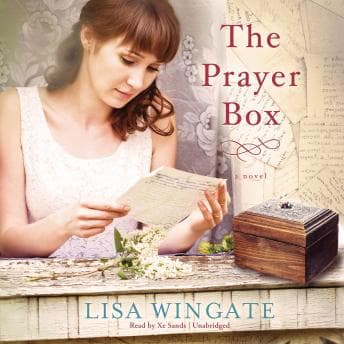

Look, I need to have a word with Lisa Wingate about making me sit in my car in the garage for an extra twenty minutes because I couldn't stop listening and also couldn't go inside with mascara running down my face. My husband already thinks the car-sitting thing is weird. Now I'm out there actively weeping. Great.
So here's the deal with The Prayer Box: it's the kind of book that sounds almost too sweet on paper. Old woman dies, young woman cleans out her house, discovers boxes full of prayers spanning eighty-one years. I know. I KNOW. But stay with me.
Tandi Jo Reese Is a Mess and I Mean That as a Compliment
Tandi is not your typical inspirational fiction heroine. She's running from an abusive situation, she's broke, she's making questionable decisions, and she's barely holding it together for her kids. And I felt that in my bones - not the abuse part, thank God, but the desperate, white-knuckle "I am one bad day away from everything falling apart" energy. Wingate doesn't sanitize Tandi's situation. She lets her be flawed and scared and sometimes selfish, which made me actually root for her instead of rolling my eyes.
Then there's Iola, who we only really know through her prayer boxes. Each box covers a year of her life, written on whatever scraps she had - napkins, receipts, torn notebook pages. The way Wingate unfolds Iola's story through these fragments is genuinely clever. You're piecing together decades alongside Tandi, and some of those prayers are so raw and specific that they hit differently than a straightforward narrative would have. Iola's not a saint. She had doubts, she had anger, she had seasons where the prayers were more desperate than peaceful. That felt real to me. That tension between faith and doubt in ordinary women's lives is something I kept thinking about when I reviewed Little Women too - different era, same ache.
Xe Sands Made Me Forget I Was Listening at 1.25x
Okay, here's where I need to be honest. Xe Sands' narration is polarizing and I totally get why. She reads with a LOT of feeling. Like, capital-L Lot. There were moments - especially during Iola's prayer passages - where she leans so hard into the emotion that the words get a little mushy. I had to rewind twice during one particularly intense section because I genuinely couldn't make out what she was saying through all the vocal quivering.
BUT. And this is a big but. When it works? It really works. Her voice has this warm, almost musical quality that's perfect for the poetic sections, and she shifts between Tandi's younger, rougher voice and Iola's gentler cadence in a way that kept me oriented even after Sophie's nap got interrupted three times by the dog barking at absolutely nothing. (The dog is on thin ice.) The distinction between the two women's perspectives was clear enough that I never had to wonder who was talking, which - if you listen to audiobooks in 8-minute increments between kid crises - is non-negotiable.
I'd say if you're someone who finds emotional narration grating, this might not be your pick. But if you can lean into it, Sands adds a layer to those prayer box passages that reading them on a page probably wouldn't deliver.
The Slow Parts Are Slow but the Payoff Earns Them
I won't pretend this book is a page-turner. The pacing dips in the middle - there's a stretch where Tandi's present-day storyline treads water while the prayer box revelations carry all the weight, and I found myself wanting to fast-forward through some of the Hatteras Island small-town business. The side characters are fine but a little thin. You've got your disapproving church ladies, your kind stranger with a secret, your predictable romantic interest.
Not groundbreaking, but sometimes you don't need groundbreaking.
What kept me going was the structure. The prayer boxes create this natural curiosity engine - you want to know what happened next in Iola's life, what she was praying about in 1962, what led to certain gaps. It's like opening someone's diary one year at a time, and that pull was strong enough to carry me through the slower stretches.
The faith themes are present and sincere. This isn't a book that's shy about its spiritual perspective, so if that's not your thing, fair warning. But it never felt preachy to me - more like listening to someone's grandmother talk honestly about what got her through hard times.
The Ending Made Me Cry at Pickup. Worth It Though.
I finished the last forty minutes during morning drop-off and the school parking lot and I did NOT make it out clean. Satisfying ending - exactly what I needed. It wraps up warmly but not falsely, and the final connection between Iola's story and Tandi's present felt earned rather than forced.
At 9 hours 38 minutes, this is a solid week-long listen. Survived 47 pauses and still made sense. Car time approved. If you loved Tending Roses or Before We Were Yours, this is quieter than the latter but has that same Wingate gift for making you care about ordinary women living extraordinary inner lives.
Who should skip: anyone allergic to faith-based fiction or who needs fast pacing. Who should grab this: tired moms who want something warm and genuinely moving that doesn't require a character wiki. My book club would love this, if I ever have time for book club again.