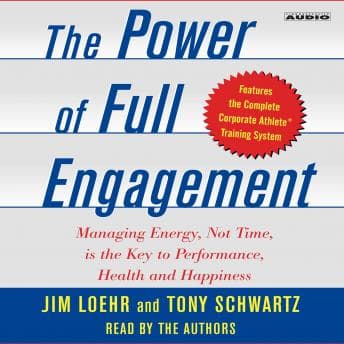
I was sitting in a Korean BBQ joint in Koreatown last Thursday waiting for Jenny - she was running 20 minutes late from her book club - and I figured I'd knock out the last hour of Jim Loehr's The Power of Story. Surrounded by the sound of sizzling galbi and my mom's voice in my head telling me to stop staring at my phone, I finished the book right as Jenny walked in. She asked what I was listening to. I said, 'A guy who charges Fortune 500 companies millions to tell them they need better internal narratives.' She said, 'So therapy with a corporate billing rate.' She's not wrong.
The First 90 Minutes Earn Their Keep
Here's what Loehr gets right, and he gets it right early: the stories you tell yourself about who you are - not your goals, not your KPIs, but the actual narrative running like background software in your head - those stories are either fueling you or draining you. He calls them 'old stories' and asks you to identify where your current story is fundamentally incompatible with where you want to go. That's a genuinely useful framework. I've sat in boardrooms with founders who have perfect pitch decks and completely broken internal narratives. The guy who tells himself 'I'm not a real CEO, I just got lucky with timing' will eventually make decisions that prove himself right. I've seen this fail at three different companies.
Loehr's background as a performance psychologist - working with elite athletes and military special forces - gives him credibility that most self-help authors can't touch. When he talks about how he helped tennis players rewrite their between-point narratives to change match outcomes, that's specific and grounded. The Human Performance Institute work is real. The results are documented. This isn't some influencer who read two psychology papers and started a podcast. Seth Godin's Practice has that same credibility problem in reverse - lots of practitioner swagger, thinner on the documented results.
Where the Story Starts Telling Itself
But here's where it goes sideways. After that strong opening framework - identify your old story, understand why it's failing you, build a new reality-based story - the book drifts into exactly the kind of self-help territory that makes my 2.0x speed finger itchy. Loehr starts cycling through examples that feel repetitive. Different client, same arc: person had bad story, person rewrote story, person's life improved. By the third hour, the pattern is so predictable you could write the next case study yourself.
One listener nailed it when they said the book has a 'great main point and some good insights up front but then it drifts.' That's exactly my experience. The core concept - that we are the authors of our own narratives and can deliberately edit them - is powerful. But it's about a 2.5-hour idea living inside a 5-hour audiobook. This is what my parents did instinctively. Now it has a TED talk. My mom never called it 'rewriting her story' when she decided the dry cleaning business was going to work no matter what. She just... decided. And then worked 14-hour days to make the decision true.
Loehr Reading Loehr - A Mixed Blessing
I'll give the man credit: there's something genuine about an author reading their own work. You can hear where Loehr actually cares versus where he's padding. His voice gets noticeably more animated when he's talking about the psychology - the mechanism of why stories shape behavior. It flattens out during the more prescriptive sections, the 'now try this exercise' parts. No dramatic vocal range, no narrator tricks. It's basically like sitting across from a smart consultant who's given this talk 500 times. Competent, authentic, occasionally a little flat. Not bad. Not electric.
At under 5 hours, this is mercifully short by business book standards. Finally, a business book that respects your time - sort of. It could've been tighter at 3 hours. But I've suffered through far worse padding.
Who Gets ROI Here
If you've never interrogated the stories you tell yourself - about your career, your capabilities, your identity - this book is a solid entry point. Particularly useful for anyone managing people, because you'll start recognizing dysfunctional narratives in your team members too. If you've already read Carol Dweck's mindset work or done any real coaching or therapy, you'll find the core insight familiar and the execution a bit thin.
Skip to chapter 5? Honestly, don't. The front half is the good half. It's the back end where your attention will wander.
The Engagement Score
Bottom line: Loehr has one genuinely useful idea - that your internal story is an editable document, not a fixed autobiography - and he delivers it with enough credibility and specificity to make it stick. The other 3 hours? Not so much. Worth a listen if you can borrow it or catch it on sale. Not worth a full credit when there are meatier business psychology books competing for your time. Jenny would say I'm being harsh. Jenny is right. But Jenny also didn't sit through the repetitive case studies.