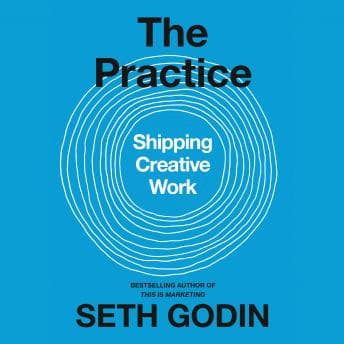

Bottom line: This is a 45-minute manifesto stretched into 5.5 hours. The core insight—that creativity is a practice, not a gift—is worth hearing. Everything else is Seth Godin doing Seth Godin things.
I finished this one during a red-eye flight to Denver, consulting gig the next morning, couldn't sleep anyway. And honestly? The repetitive, aphoristic style that drives some listeners crazy actually worked at 35,000 feet with my brain running on fumes. Each little nugget landed, then I'd zone out, then another one would hit. Not sure that's a compliment.
What My Parents Already Knew
Here's the thing about Godin's central thesis—that you show up, do the work, ship it, repeat—my folks did this every day for thirty years with a steam press and a cash register. No TED talk required. They didn't wait for inspiration. They didn't worry about imposter syndrome. They just... worked.
But I'll give Godin credit: he articulates why that matters for creative work specifically. The bit about writer's block being a myth? That's not dismissive—he's reframing it as a choice. You're not blocked. You're choosing not to write. That distinction hit different when I was staring at a blank strategy deck at 2 AM. Breaking the Habit of Being Yourself makes a similar argument about reframing mental blocks—though Dispenza wraps it in neuroscience instead of creative philosophy.
The framework is solid: trust the process, detach from outcomes, make promises and keep them. Basically Stoicism meets shipping deadlines. If you've read Linchpin or Tribes, you've heard variations of this. If you haven't, this might genuinely rewire how you think about creative output.
The Godin Delivery Problem
Seth narrates his own book. This is either a feature or a bug depending on your tolerance for his particular style—measured, confident, occasionally veering into motivational speaker territory. He's not boring exactly, but he's... consistent. Same cadence. Same tone. For five and a half hours.
I bumped it to 2.0x around hour two. Still felt slow.
The structure doesn't help. It's written as a series of short, standalone sections—almost like blog posts stitched together. Great for the original Akimbo workshop format, less great for sustained listening. My attention kept drifting. I'd catch myself three sections ahead with no memory of what just happened.
Some listeners apparently couldn't make it past hour one. I get it. If you're looking for narrative arc or case studies or anything resembling story, you won't find it here. This is pure philosophy delivered in bite-sized chunks.
The One Insight Worth Your Time
If I could hand you the essence: Creativity isn't about waiting for permission or inspiration. It's about making a commitment to ship—to put work into the world before you feel ready, before it's perfect, before you're sure anyone will care. The practice IS the point. The outcome is secondary.
That's it. That's the book.
Godin circles this idea from about forty different angles, which some people find reinforcing and others find maddening. I landed somewhere in the middle. By hour four, I was getting the message. By hour five, I was checking how much time was left.
Who Gets Value Here (And Who Doesn't)
Creative people paralyzed by perfectionism—this might unstick you. First-time entrepreneurs afraid to launch—useful perspective. Anyone who's read Godin before and loved him—more of what you came for.
But if you're already shipping regularly? If you've internalized the "done is better than perfect" mindset? You're not learning anything new. You're just getting a 5.5-hour affirmation of what you already practice. Also skip this if you need concrete tactics. This is philosophy, not playbook. No step-by-step frameworks. No templates. Just Godin telling you to trust the process while you figure out what your process actually is.
The ROI Calculation
I've recommended this to exactly two clients. Both were founders who kept delaying launches because nothing was "ready yet." For them, this was medicine.
For the rest of my clients—the ones already grinding, already shipping, already in the arena—I tell them to save the credit. Same advice I give about Good Leaders Ask Great Questions—solid core ideas, but experienced practitioners can extract the value faster than the full listen requires. Read the summary. Get the insight in fifteen minutes and move on.
Jenny would say I'm being harsh. Jenny is right. But also: time is money, and most of us don't have 5.5 hours to hear what could be said in one. The ideas are sound. The execution is padded. At 2.0x speed with low expectations, it's a decent flight companion.
At full price and full speed? Wait for the sale.