
Look, I'm going to be annoyed about this upfront: this book is basically telling me everything I already know is wrong but in a way that makes me feel personally attacked. You're not tired because you need more time. You're tired because you're treating your body like a server that never needs a restart. Cool. Thanks. I definitely needed to hear that at 6:47 AM on a packed Caltrain while running on four hours of sleep and my third cold brew.
But here's the thing - they're right. And I hate that they're right.
The Athletic Model for Knowledge Workers
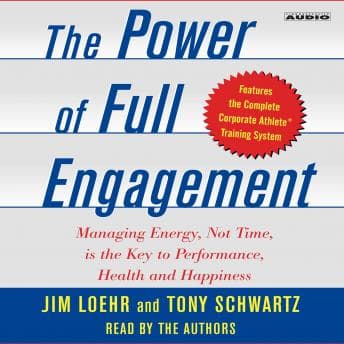
Loehr and Schwartz's core premise is almost embarrassingly simple: elite athletes train in cycles of stress and recovery. They don't go 100% all the time. But knowledge workers? We just... grind. Forever. Until we break. The book frames energy management across four dimensions - physical, emotional, mental, and spiritual - and argues that neglecting any one of them tanks your performance across all of them.
This is basically distributed systems theory but for humans. You can't just scale horizontally forever. Eventually you hit resource limits and everything degrades. The authors use case studies from their corporate consulting work - executives who were burning out, athletes who lost their edge - and walk through how restructuring their energy rituals (their word, not mine) led to sustained performance.
At 4 hours 18 minutes, this could've been a blog post. I'm saying that as a compliment. There's no padding here. Every chapter has a clear point, practical examples, and moves on. I finished it in 3 commutes, which is exactly right for a business book.
Authors Who Actually Belong Near a Microphone
Author-narrated business books are usually a gamble. Some authors have no business near a microphone. But Loehr and Schwartz actually pull this off. Their delivery is clear, conversational, and - this matters - they sound like they genuinely believe what they're saying. When Loehr talks about working with tennis players and executives, you can hear the decades of experience. It's not polished in a voice-actor way, but it's authentic.
The production is clean. No weird background noise, no jarring edits. Just two guys explaining their framework like they're giving a really good conference talk. I bumped it to 1.5x after the first hour because the pacing is measured enough to handle the speed increase without losing anything.
The ROI Calculation
Here's where I get practical, because that's what you're here for. The actionable stuff in this book:
- Rituals over willpower. Don't rely on motivation. Build specific routines that trigger the behavior you want. Your Best Life Now covers similar ground on building intentional habits, though with way more God references and less data. They're basically describing habit stacking before James Clear made it trendy.
- Strategic recovery. Taking breaks isn't weakness, it's maintenance. Schedule them like you schedule meetings.
- Energy audits. Track where your energy goes the same way you'd track time. What activities drain you? What recharges you? Optimize accordingly.
The spiritual energy section might lose some people - it's really about purpose and meaning, not religion - but it's the shortest section and honestly, it's the one that stuck with me most. If you don't know why you're doing what you're doing, no amount of sleep optimization is going to fix the burnout.
My one complaint: the book is from 2003, and while the principles are timeless, some of the examples feel dated. The executives they profile are dealing with early 2000s corporate culture, not Slack notifications and always-on remote work. The framework still applies - maybe even more so now - but you'll need to do some mental translation.
Who Needs This (and Who Doesn't)
This is for you if: you're a high performer who's starting to feel the cracks, you manage your calendar obsessively but still feel exhausted, or you've ever fixed a production outage at 2 AM and then wondered why you couldn't focus the next day. (Guilty.)
Skip if: you want a book that validates hustle culture, you're looking for quick hacks without the underlying philosophy, or you need entertainment value from your audiobooks. This is a textbook dressed in business casual.
I sent Kevin the chapter about recovery rituals and he just texted back "so you're saying I was right about the naps." He was right about the naps.
The Commit Message
Bottom Line: Worth your commute. The ROI on this audiobook is high if you actually implement even one ritual from it. It's not going to change your life just by listening - you have to do the work - but the framework is solid and the authors know their stuff. At under 5 hours, it respects your time while delivering genuine value.
I'm now scheduling my recovery intervals like sprint retros. We'll see if it helps with the 2 AM incidents. Probably not. But at least I'll know why I'm tired.