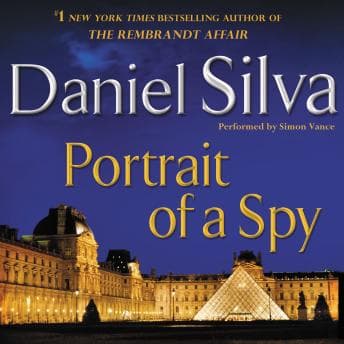

People keep telling me Daniel Silva is the gold standard of modern spy fiction. Eleven books deep into the Gabriel Allon series with Portrait of a Spy, and I'm starting to wonder if the gold's wearing a little thin.
Let me cut to the chase: this is a competent spy novel with excellent narration that moves at the speed of a Pentagon procurement meeting. If you want explosions and gunfights, look elsewhere. If you want tradecraft, geopolitics, and the kind of slow-boil intelligence work that actually looks more like real-world ops than most fiction admits - well, it's here, but buried under a lot of description that tested even my patience.
Gabriel Allon: Art Restorer, Spy, and the Quietest Action Hero in Fiction
I was up late working a threat assessment for a client's overseas facility - the kind of tedious document review that pairs well with an audiobook running in the background. Bad choice for this one. Portrait of a Spy demands your full attention because Silva packs the plot with characters and shifting locations - Paris, Copenhagen, London's Covent Garden, Washington, the Middle East - and if you zone out for ten minutes, you've lost the thread on who's funding which terror network and why Allon is suddenly in a different country.
The premise is solid enough: Allon witnesses a bombing at Covent Garden, gets pulled back into service, and ends up hunting a terrorist financier through a web of Saudi money and jihadist cells. Silva clearly did his homework on intelligence community dynamics, particularly the friction between CIA and Israeli intelligence. The bureaucratic turf wars ring true - I've seen this scenario play out in real life, the interagency finger-pointing and credit-grabbing. That part felt authentic.
But here's where it lost me: the pacing. For a book about hunting terrorists after multiple mass-casualty attacks, there's a surprising lack of urgency. Silva spends long stretches on Allon's art restoration work - which, okay, it's his cover and his passion, I get it. But when you're eleven books into a series and still spending pages on how he approaches a canvas, it starts to feel like padding. The middle third especially drags. I found myself bumping the speed up to 1.5x during some of those passages, and I'm already a 1.25x guy.
The character roster is another issue. There are a lot of players here - intelligence officers, politicians, Saudi royals, art world figures - and Silva introduces them with full biographical sketches that read more like dossiers than storytelling. Useful if you're briefing a general, less useful if you're trying to remember who's who during hour seven of an audiobook.
Simon Vance Does the Heavy Lifting
Now, Simon Vance. The man is a professional and it shows. His default narration voice has this measured, authoritative quality that suits the intelligence world perfectly - like listening to a BBC correspondent who moonlights at MI6. He differentiates characters with distinct accents - British, Israeli, American, Arabic - and for the first several hours, it works beautifully. You always know who's talking.
But. Eleven hours and twenty-six minutes is a long time to sustain that many accents, and somewhere around the back half, it started wearing on me. Not because Vance is bad - he isn't - but because there are so many characters cycling through that the accent-switching becomes relentless. (Ranger lifted his head a few times during some of the more theatrical voice shifts, which is his version of a mixed review.)
Vance's real strength here is his pacing and tone control. He handles the quieter, more reflective passages with genuine weight, and when the tension finally does ramp up in the last act, he shifts gears convincingly. If the book had given him more to work with in terms of action and urgency, this would've been a knockout performance.
Who This Is Actually For
If you're new to Gabriel Allon, this is a decent entry point - you'll find the character interesting, the geopolitics relevant (the Saudi angle still hits), and the tradecraft detailed enough to feel smart without being impenetrable. If you're a longtime series reader, you might feel like you've been here before. The formula - Allon gets pulled out of retirement, reluctantly saves the day, goes back to his paintings - is starting to show its seams by book eleven.
This is not a workout book. Not a background-noise-while-cooking book. This requires focus, a long drive, or a quiet room. I said something similar about String of Pearls - another one that punishes distracted listening and rewards the kind of attention most people stopped giving books somewhere around 2015. Treat it like an intelligence briefing: show up alert or don't show up.
Mission Debrief
Worth your time? Here's the debrief: Portrait of a Spy is a well-researched, professionally narrated spy novel that would be a solid 4-star effort at 8 hours. At nearly 11 and a half, it's stretched past its operational value. Silva knows the intelligence world, Vance knows the microphone, but the book needed an editor with a red pen and zero patience for filler. I didn't regret the listen, but I won't be replaying it. Ranger slept through the middle third, and honestly, I can't blame him.