
Everyone kept telling me Steve Cavanagh was "Grisham but Irish and angrier." I went in skeptical. I came out at 1 AM, standing in my kitchen over a pot of dal that had gone cold two hours ago because I forgot to turn the stove back on. That's the kind of book this is.
The Con Artist Who Can't Stop Caring
Eddie Flynn is a fascinating case study in contradictory identity. He's a former con artist who became a lawyer — which, yes, the book is aware of the joke, and no, it doesn't beat you over the head with it. What makes this character psychologically interesting is that his con man instincts aren't a liability he overcomes; they're his primary toolkit. He reads people the way I read research papers: looking for the inconsistencies, the places where the story doesn't hold. The protagonist exhibits classic hypervigilance patterns — always scanning, always calculating exit strategies — but Cavanagh roots it in genuine moral distress rather than cool-guy posturing.
The setup is essentially a psychological trap: the FBI has leverage over Eddie's wife, and they want him to convince a possibly innocent billionaire to plead guilty. So Eddie is forced into the role of manipulator against his own conscience. I found myself asking: why does Eddie really keep fighting when the smart move — the con man move — would be to just get the plea and walk away? The answer the book gives is more interesting than simple heroism. It's compulsion. Eddie can't not solve the puzzle. My therapist would have thoughts about this character.
The opening scene drops you into Eddie getting shot, then rewinds. It's a structural choice that could feel cheap, but here it works because it reframes everything that follows as a countdown. You know violence is coming. You just don't know who's holding the gun or why.
A Locked Room That Actually Locks
The mystery itself — did David Child kill Clara? — is structured as a locked room problem layered inside a legal thriller layered inside a conspiracy plot. The security footage shows nobody else entering the apartment. The murder weapon was in David's car. Gunshot residue on his hands. Psychologically, this doesn't track with David's behavior, and Eddie picks up on the same dissonance I did, which is honestly refreshing. Too many thriller protagonists ignore obvious psychological cues because the plot needs them to be slow. Eddie isn't slow.
Cavanagh, who is actually a practicing lawyer, clearly understands how courtrooms feel from the inside — the weird mix of theater and bureaucracy, the way a case can pivot on a single procedural detail. The courtroom scenes have a lived-in quality that separates them from the Hollywood version. The research actually shows that people form judgments about guilt within seconds of seeing a defendant, and the book plays with exactly that bias. David looks guilty. The evidence says guilty. The system wants guilty. Eddie's job is to find the crack in what looks like a perfect wall.
The FBI agents pressuring Eddie aren't cartoon villains either. They genuinely believe their money laundering case matters more than one man's innocence. It's a conflict of utilitarian ethics versus individual justice, and the book is smart enough not to make the answer simple.
Adam Sims Gets Eddie Flynn's Brain
Adam Sims narrates with a brash, streetwise energy that fits Eddie like a glove. He captures the specific register of a guy who grew up running cons and then had to learn how to sound credible in a courtroom — there's an edge underneath the polish, a slight impatience when Eddie is forced to play nice with authority. The character voices are distinct enough that I never lost track of who was speaking during dialogue-heavy courtroom scenes, which at nearly twelve hours is no small feat.
The pacing is relentless. I started this during a Saturday morning jog through Cambridge and ended up extending my route by two miles because I couldn't stop at a cliffhanger. Then I brought it into the kitchen and — well, you know what happened to the dal.
Who Gets the Most Out of This
If you like Michael Connelly's Mickey Haller but wish he had a slightly more dangerous past. The courtroom-as-theater dynamic also shows up in Interlude in Death, though that one wraps its procedural tension inside a locked-room mystery on a space station, which is either your thing or it absolutely isn't. If you enjoy legal thrillers where the lawyer is genuinely smarter than everyone in the room but still might lose because the system is rigged. If you've ever read a courtroom scene and thought "that's not how any of this works" — Cavanagh actually knows how it works, and it shows.
Skip this if you want a slow-burn literary mystery. This is fast, it's propulsive, and it will not wait for you to catch up. Also not ideal for bedtime unless you're fine with staying up until 2 AM. I am apparently fine with that.
The Case File Stays Open
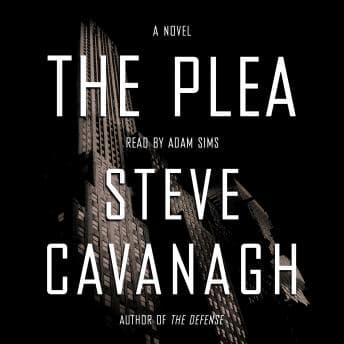
The Plea won the Prix Polar Award for Best International Novel, and I get it. This is a book that understands the psychology of pressure — how it warps decision-making, how it reveals character, how people behave when every option is a bad one. Eddie Flynn is the kind of protagonist who makes you want to study his file. I'm already queuing up the next one.