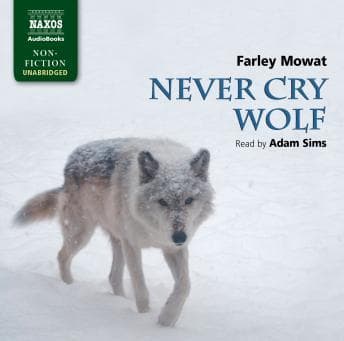

"I had made my decision. I was going to go there and study wolves."
Something close to that kicks off Farley Mowat's account of being dropped into the Canadian Arctic by a government that wanted him to prove wolves were slaughtering caribou. Spoiler from 1963: the wolves were not the problem. But the way Mowat figures that out - by essentially becoming a one-man distributed system monitoring a wolf pack's every behavior for an entire summer - that's the real payload here.
I started this on a Sunday morning while Kevin was still asleep and I was stress-cleaning the kitchen after a week of particularly gnarly on-call rotations. Finished it before dinner. Under five hours. And honestly? It was exactly the kind of palate cleanser my brain needed after mainlining a 40-hour space opera the week before.
A Software Engineer Assigned to Debug an Ecosystem
Here's the thing that hooked me as someone who spends her days tracing signal through noise: Mowat's methodology is basically observability for wolves. He sets up camp near their den, creates his own little monitoring pipeline, and starts logging everything. Feeding patterns, social hierarchies, territorial boundaries - he's instrumenting the tundra. And when his initial hypothesis (wolves = caribou killers) doesn't match the data, he does what any good engineer should do: he follows the evidence instead of the spec. It's the same instinct that makes How To Lie With Statistics such a useful read - the whole thing is basically a field guide to what happens when you let the conclusion drive the data instead of the other way around.
The book is funny in that dry, self-deprecating way where Mowat is completely aware he's the least competent creature on the tundra. There's a running bit where he marks his own territory with urine to establish boundaries with the wolf pack - inspired by watching the alpha male do the same - and the wolves basically humor him like you'd humor a toddler who insists they're helping you cook. The whole dynamic shifts from "scientist studies subjects" to something more like mutual bewilderment.
What surprised me is how well the science actually holds up for a book written sixty years ago. Mowat's observations about wolves being primarily mouse-eaters during summer, about their complex family structures, about how the caribou herds were actually being decimated by human hunters - a lot of this has been confirmed by modern wolf research. Some of his specific claims have been disputed (he may have compressed timelines and embellished certain encounters), but the core argument was decades ahead of its time.
Adam Sims Narrates Like He's Telling You This Story Over a Campfire
Adam Sims has this soft, slightly wistful quality that works perfectly here. He sounds like someone recounting an adventure from memory, not performing a text - which is exactly right for a book that's essentially one man's field journal turned memoir. His voice carries the humor without overselling it. When Mowat describes the wolves' nightly howling sessions or his increasingly desperate attempts to communicate his findings to a bureaucracy that doesn't want to hear them, Sims lets the absurdity land without mugging.
He does differentiate between the few human characters - the Inuit hunters Mowat encounters get a quieter, more reserved delivery that contrasts with Mowat's own breathless narration style. It's not a book that demands a huge vocal range, but Sims handles the tonal shifts from comedy to genuine wonder to quiet anger (at the government, at the hunting industry) with enough subtlety that nothing feels jarring.
No complaints on production. Clean audio, no weird artifacts. Single narrator, no sound effects, which is correct for this kind of book. You don't need ambient wolf howls; Mowat's descriptions do the work.
Who This Is For (And Who Should Probably Skip)
Perfect for: train, gym, housework. The narrative is linear and vivid enough that you won't lose the thread if someone bumps into you or your kettle starts screaming. At under 5 hours, the ROI on this audiobook is excellent - it's a complete, satisfying experience with zero filler. I finished this in essentially one sitting, which almost never happens for non-fiction.
Skip if you need rigorous peer-reviewed science and nothing else. Mowat was a storyteller first, and some of his accounts read more like creative non-fiction than a research paper. If that bothers you, you'll spend the whole book side-eying the narrative. But if you can accept it as one person's deeply personal (and occasionally embellished) account of falling in love with an animal the entire world wanted to demonize? It's kind of wonderful.
Also genuinely useful if you're interested in how conservation narratives get shaped. This book literally changed Canadian policy on wolves. A five-hour audiobook that moved the needle on an entire species' survival. Try getting that ROI from your average business book.
Commit, Push, No Regrets
TL;DR: Worth your commute. A funny, sharp, surprisingly scientific account of one man's summer living with wolves - and realizing humans were the real bug in the system. Under five hours, zero drag, and Adam Sims narrates it like a story you'd want told twice. At 1.5x this is basically a long podcast episode that's better than 90% of actual podcasts.




![Steve Jobs [unabridged audiobook] audiobook cover](/_next/image?url=https%3A%2F%2Fcovers.audiobooks.com%2Fimages%2Fcovers%2Ffull%2F9788499923406.jpg&w=1920&q=75)