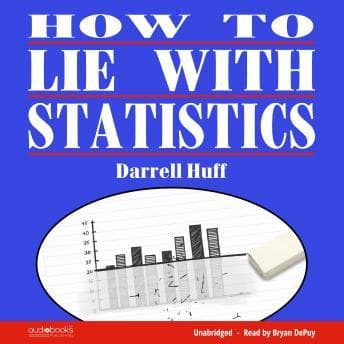

Three hours. This book is three hours long. I almost cried when I saw that runtime. Finally, a business book that respects your time.
Look, I've sat through so many bloated 12-hour audiobooks that could've been a LinkedIn post. Darrell Huff wrote this thing in 1954 and somehow understood what most modern authors don't: make your point, make it well, and get out. My parents would've appreciated this efficiency. They didn't have time for fluff between the 6 AM opening and the 9 PM close.
The BS Detector You Didn't Know You Needed
Here's the thing - I've been in boardrooms where executives throw around statistics like confetti. "Our customer satisfaction is up 40%!" Great. Forty percent of what? Measured how? Compared to when? Huff wrote this book seventy years ago and it's still exposing the same tricks I see in pitch decks every week.
The chapter on sample bias alone is worth the listen. Huff breaks down how a "study" can be technically accurate and completely misleading at the same time. I've seen this fail at three different companies. One client was making major product decisions based on a customer survey that only went to people who'd already complained. Shocking that the results were negative, right?
What kills me is how simple the manipulation techniques are once you see them. Truncated graphs that make a 2% change look like a revolution. Averages that hide more than they reveal. Correlation dressed up as causation. This is what my parents did instinctively - they'd look at a vendor's "data" and just... know something was off. Now it has a TED talk. Or at least, it should.
Bryan DePuy Earns His Keep
I wasn't sure what to expect from the narrator. Statistics books can go real dry real fast, even short ones. But DePuy keeps things moving. His delivery is clean and engaging without being overly dramatic - exactly right for this material. You don't need theatrical flourishes when you're explaining how pharmaceutical companies cherry-pick their trial data.
The pacing works perfectly at 1.5x (yes, I dialed it down from my usual 2.0x - the concepts deserve a bit more processing time). DePuy handles the dated examples well, and there are some dated examples. 1950s advertising references, old salary figures, that kind of thing. But honestly? The manipulation tactics haven't changed. Just the medium.
Where 1954 Meets Right Now
Okay, so the book shows its age in spots. Some of the cultural references are pretty dusty, and Huff's occasional attempts at humor land differently now. But here's what's wild - swap out "magazine advertisements" for "social media infographics" and every single chapter applies to 2024.
The section on "How to Talk Back to a Statistic" should be required listening for anyone who's ever shared an article based on the headline. Huff gives you five questions to ask about any statistic you encounter. Simple stuff. Who says so? How do they know? What's missing? Did somebody change the subject? Does it make sense?
I've started using these in client meetings. Not in an obnoxious way (Jenny would say I'm being harsh - Jenny is right). Just quietly applying the framework. It's amazing how often the impressive-sounding numbers fall apart under basic scrutiny.
The Efficiency Play
The key takeaway is worth the listen. The other 2.5 hours? Also worth it. That's rare for me to say.
This isn't a book that's going to revolutionize your career or unlock passive income or whatever the business book industrial complex is promising this quarter. Who Moved My Cheese tried to do the career revolution thing with its maze metaphor—this is better because it just arms you with tools. It's more fundamental than that. It teaches you how to not be fooled. In a world where everyone's got data to prove their point, that's a genuinely useful skill.
Who Should Listen (And Who Should Skip)
Anyone who sits through presentations, evaluates vendor claims, or just wants to stop getting fooled by headlines. Skip it if you already have a solid stats background—this is foundational, not advanced.
Bottom line: Three hours, zero filler, immediately applicable. Bill Gates recommends it as a beach read, which is the most Bill Gates thing I've ever heard. But he's not wrong. This is the rare business book that delivers exactly what it promises and doesn't waste your time doing it. My 2.0x speed couldn't save most audiobooks - this one didn't need saving.






![Steve Jobs [unabridged audiobook] audiobook cover](/_next/image?url=https%3A%2F%2Fcovers.audiobooks.com%2Fimages%2Fcovers%2Ffull%2F9788499923406.jpg&w=1920&q=75)