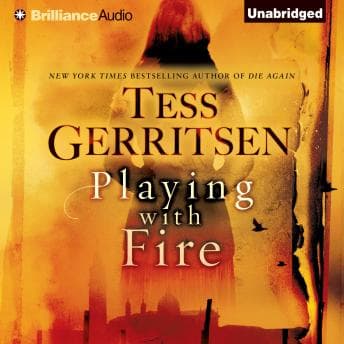

This book is a ghost story disguised as a thriller, and the ghost is a waltz.
I finished Playing with Fire at 2 AM on a Tuesday, sitting cross-legged on my kitchen floor because I'd gotten up to refill my water and just... never made it back to bed. Diego was doing that thing where he stares at the dark hallway like he sees something I can't, which — given the subject matter — was NOT helpful. But I couldn't stop. Not because of the suspense, exactly. Because of the weight of it. The way this book carries grief like a stone in its pocket.
The Waltz That Burns Everything It Touches
Here's the premise: violinist Julia Ansdell finds a mysterious piece of sheet music in a Roman antique shop — the "Incendio Waltz" — and when she plays it, her toddler daughter starts doing violent, terrifying things. Smashing, hitting, setting things on fire. And Julia blacks out during the performances. So you've got this mother who's watching her child become something unrecognizable, and she doesn't know if the music is cursed or if she's losing her mind or if — and this is the gut-punch option — her daughter was always this way and she just didn't want to see it.
That tension between "is this supernatural or is this a woman unraveling" kept me locked in for the entire seven hours. Gerritsen plays both sides so well that I genuinely didn't know where she was going, which is rare for me. I've listened to probably 200 thrillers at this point. I usually clock the twist by hour three. This one? She got me.
But the real heart of the book isn't Julia's story. It's Lorenzo's.
Lorenzo's Thread Wrecked Me and I'm Still Not Over It
The dual timeline switches between Julia's present-day investigation and Lorenzo's life in WWII Italy — a young man caught up in love and music and then the Holocaust swallowing everything whole. Will Damron narrates Lorenzo's sections, and his voice is so tender, so careful with this character, that you feel the tragedy building before it arrives. There's a quality to Damron's delivery that reminds me of someone telling you a story they've carried for decades, and they're finally letting it out. Quiet. Measured. But full.
I ugly-cried during the author's note. THE AUTHOR'S NOTE. Because Gerritsen talks about the real history behind the story, and after spending seven hours living inside Lorenzo's world, hearing the real-world echoes just — it broke something open.
Abuela would have loved this one. She had this thing about stories where music carries memory, where songs outlive the people who wrote them. She used to hum boleros that her own mother taught her, and she'd get this look on her face like she was somewhere else entirely. That's what the Incendio Waltz feels like in this book — not just notes on a page but a vessel for something survived.
Julia Whelan, My Queen, But Also — The Husband Thing
Okay. I need to be honest because Julia Whelan is basically my audio comfort blanket and I would listen to her read tax forms. Her narration of present-day Julia is gorgeous — the fear, the obsession, the desperation of a mother who can't protect her child from something she doesn't understand. Whelan does scared-but-stubborn better than anyone.
BUT. Her male voices. Specifically the husband. There's this condescending edge to how she voices him that made me want to reach through my earbuds and shake him, and I genuinely can't tell if that's intentional characterization or just the limitation of a female narrator doing male dialogue. Either way, it pulled me out a few times. Not enough to ruin anything, but enough that I noticed. And I don't usually notice with Whelan because she's that good — so when something snags, it snags hard.
Damron, though? No notes. Give that man more dual-narration work.
Who This Is For (And Who Should Maybe Not)
If you want a book that feels like a minor key — beautiful but unsettled, with something aching underneath — this is your rainy Sunday book. It's short enough to finish in a day, emotional enough to stay with you after. The haunted, unresolved quality reminded me of what Poe does so well in Works of Edgar Allan Poe, Raven Edition, Volume 1 — that particular flavor of dread where the horror is always just slightly out of focus, and the not-knowing is the whole point.
If you need your thrillers to be airtight and your endings to tie every thread into a neat bow... you might leave frustrated. The ending is divisive. I didn't hate it, but I sat with it for a long time, turning it over. It's the kind of ending that asks you to decide what you believe, and some people just want to be told.
Also if you're a Rizzoli & Isles devotee expecting that energy — recalibrate. This is quieter, stranger, more haunted. Less procedural, more emotional excavation.
The Last Note
This book felt like finding an old photograph inside a library book — someone else's memory that suddenly becomes yours. Imperfect in places, yes. A little rushed in its final act. But the emotional core — music as inheritance, music as curse, music as the thing that survives when people don't — that hit me somewhere I wasn't ready for.
Four crying sessions. Diego judged every single one.