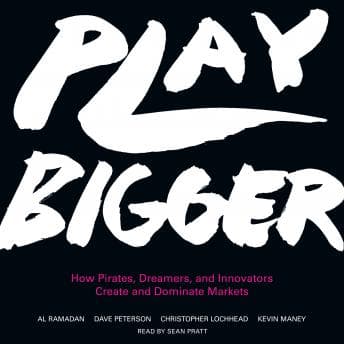

Every business book written by consultants has the same problem: they're selling you the framework they sell their clients. Play Bigger is no exception. But here's the thing - this particular framework is actually useful, which puts it ahead of about 80% of what's cluttering my Audible library.
The core thesis: don't compete in existing categories, create new ones. Companies like Uber, Salesforce, and Airbnb didn't just build better products - they defined entirely new market categories and then conditioned consumers to think in those terms. The authors call these companies "category kings" and claim they capture 76% of the total value in their categories. That stat alone earned my attention during a late-night spreadsheet session that was going nowhere.
The Part Your Parents Already Knew
Here's what got me. My parents didn't read business books. They ran a dry cleaning operation in Koreatown and somehow understood that you don't compete on price with the place across the street - you make yourself the only option for a specific kind of customer. Same-day alterations, Korean-language service, open at 6 AM for the restaurant workers. They didn't call it "category design." They called it survival. This is what my parents did instinctively. Now it has a TED talk.
But the book does go beyond instinct. The authors break category design into a deliberate process: identify a problem people don't realize they have (or can't articulate), design the category around that problem, then align your company, product, and category strategy into what they call a "Lightning Strike" - a big, orchestrated push to claim ownership of the space. The Lightning Strike chapter is genuinely tactical. Most business books give you the "what" and skip the "how." Play Bigger at least tries to hand you a playbook.
The data analysis on category kings versus category followers is the strongest section. When they show how the economics of category dominance work - why being second in a new category is exponentially worse than being first - it clicks. I've seen this pattern play out with at least three startups I've advised. The ones that tried to be "Uber but for X" instead of defining their own space? Dead. Every one.
Where 8 Hours Becomes About 4 Hours of Real Content
And here's where I get honest. The key takeaway is worth the listen. The other 7 hours? Not so much. There's significant repetition. By the third time they explain what a category king is using slightly different examples, you're ready to fast-forward. The case studies - Salesforce, 5-hour Energy, Uber - are interesting but treated with the reverence of scripture rather than examined with any real critical lens. Where are the category design attempts that failed spectacularly? The survivorship bias here is thick enough to cut.
Also, and this bugs me as someone who's actually helped companies with positioning: the book conflates correlation with causation pretty aggressively. Did these companies succeed because they consciously designed categories? Or did they succeed for fifteen other reasons and the category dominance was a byproduct? The authors are too invested in their own framework to ask that question honestly.
Sean Pratt's narration is clean and professional - the guy's a seven-time AudioFile Earphones Award winner and it shows. He keeps a steady, authoritative pace that works for this kind of material. Not flashy, but you're not fighting the narrator to get to the ideas, which is all I ask from a business audiobook. At 2.0x he sounds like a slightly caffeinated newscaster, which is basically perfect.
Who Gets ROI on This
If you're a founder trying to figure out positioning, or a product leader tired of feature-war thinking, skip to chapter 5 and work forward. Thank me later. The Lightning Strike framework and the discussion of "Frosting" (their term for how incumbents try to absorb new categories by adding features) are genuinely useful mental models.
If you've already read Crossing the Chasm and The Innovator's Dilemma, this fills a legitimate gap in the trilogy. If you haven't read those... honestly, start there. Good to Great belongs on that same shelf too - Collins at least wrestles with why some companies flame out even when they do everything right, which is the intellectual honesty Play Bigger keeps dodging.
If you're looking for rigorous research or anything resembling academic honesty about when this framework doesn't work? Keep looking.
The Consulting Engagement You Can Actually Afford
Bottom line: Play Bigger packages a genuinely important strategic idea - that category creation matters more than product competition - into a format that's about 60% signal, 40% padding. The signal is strong enough to justify the listen. I knocked it out during a red-eye to Boston and a cab ride to a client site, and I walked into that meeting with better language for a conversation I'd been struggling to frame. That's a win. Jenny would say I'm being harsh about the repetition. Jenny is right. But at 2.0x speed, the repetition is survivable, and the core framework might save your company from the slow death of competing in someone else's category.