
Look, I need to get something off my chest: I am a fifty-year-old man who teaches Faulkner and Hemingway for a living, and I just spent twelve hours listening to a rom-com in Italian. In Italian! A language I speak with roughly the confidence of a tourist ordering gelato. And I loved it. Denise is never going to let me live this down.
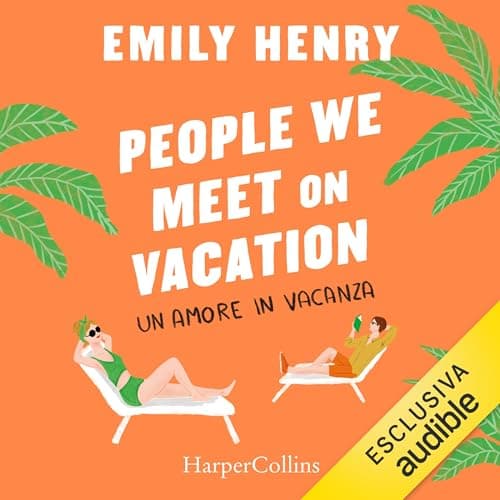
Here's how it happened. She's been studying Italian on Duolingo for two years now — she's got one of those terrifying streaks, 700-something days — and she wanted us to listen to something together on our Saturday lakefront walks. She picked Emily Henry's People We Meet on Vacation in its Italian edition, L'amore in vacanza, narrated by Irene Geronimi. I protested. I said I had a Dostoyevsky reread queued up. She handed me my headphones and said "Cammina." So I walked.
The English Teacher Who Couldn't Stop Listening in Italian
Here's what surprised me: even with my patchwork Italian, the emotional architecture of this book is so clean, so structurally smart, that I followed every beat. Emily Henry alternates between past and present — ten years of summer vacations between Poppy and Alex, shuffled like a deck of cards against the present-day trip where they're trying to repair a two-year silence. It's a device I've seen students attempt in creative writing workshops and butcher every single time. Henry doesn't butcher it. Each timeline jump earns its place, and the Italian translation by Valentina Zaffagnini keeps that rhythm intact. The prose is — and I'm pulling from what Italian I could parse — conversational without being flimsy. Scorrevole, as the Italian readers say. Flowing.
But let's talk about what the author is really saying underneath the vacation hijinks and the will-they-won't-they tension. This is a book about the terror of wanting something so badly you'd rather lose a person than risk asking for it. Poppy and Alex orbit each other for a decade, and the thing keeping them apart isn't miscommunication or bad timing — it's the deliberate choice to stay safe. That's a more honest portrait of how people actually sabotage love than most literary fiction manages, and I say that as someone who assigns The Age of Innocence every spring.
Irene Geronimi and the Problem of One Voice for Two Hearts
Now, the narration. Irene Geronimi has a warm, natural delivery — the kind of narrator who sounds like she's telling you a story at a dinner party rather than performing. Her emotional range is genuine; there's a shift in the later hours when Poppy starts confronting what actually happened two summers ago, and Geronimi's voice gets quieter, more cautious, in a way that felt earned rather than theatrical. She understands that pause is punctuation.
But here's the rub, and it's the same complaint Italian readers have flagged: we never get Alex's point of view. Geronimi is locked inside Poppy's head for all twelve hours, and while she does good work differentiating dialogue, Alex remains slightly out of focus. You feel his presence through Poppy's longing, which is effective — but I kept wanting to hear his side of that catastrophic last vacation. The book withholds it, and while I understand that's Henry's structural choice, twelve hours is a long time to spend with only one half of a love story. My students would call this a "trust fall with the reader." I'd call it a gamble that mostly pays off.
At 12 hours and 9 minutes, the pacing is comfortable — never rushed, occasionally indulgent in the middle vacation flashbacks (the Nashville trip drags compared to the others), but the emotional payoff in the final stretch is worth the patience.
Who Gets a Plane Ticket (And Who Stays Home)
If you love slow-burn romance where the tension comes from what's unsaid rather than manufactured drama, and you want to practice your Italian while you're at it — this is your book. If you loved Beach Read (Henry's other big hit), this is its spiritual successor, warmer and more structurally ambitious. And if you're an audiobook listener who appreciates a narrator who doesn't oversell the emotional moments, Geronimi is a steady, trustworthy guide.
Skip it if you need dual POV to feel invested in a romance, or if you're looking for something with more conflict and less introspection. Though if you want introspection paired with genuine emotional stakes, I gave The Surrogate Mother a spin recently and found it does something similar — characters trapped by what they can't bring themselves to say out loud. And if your Italian is worse than mine — which is saying something — you might want the English edition first.
The Annotation in the Margin
I finished this on a Tuesday night, grading sophomore essays on Their Eyes Were Watching God, and I caught myself thinking about Poppy and Alex the way I think about Janie and Tea Cake — not as comparable love stories, obviously, but as characters who understand that the scariest thing in the world is letting someone see you clearly. Emily Henry writes rom-com with a literary heart. I'm not saying I'm assigning this in AP English. But I'm not not thinking about it.
Denise, for the record, cried during the last chapter. I did not. (I did.)