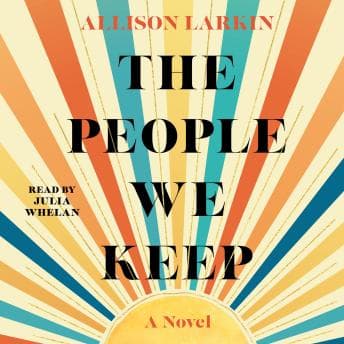

"I don't know how to stay."
That line hit me somewhere around hour three, and I had to pause my design work because my eyes were too blurry to see the screen. April Sawicki says it so simply, like it's just a fact about herself—like saying she has brown hair or prefers coffee black. But Julia Whelan delivers it with this quiet devastation that made me understand everything about this girl in six words.
I ugly-cried four times during this book. Four. (Yes, I added it to the spreadsheet.)
The Voice That Became April
Look, I've listened to a lot of Julia Whelan. The woman is basically the patron saint of audiobook narration at this point. But something about her performance here felt different—more raw, maybe? Her husky timbre has this questioning undertone throughout, like April herself is never quite sure she deserves the good things happening to her. And honestly, that uncertainty? It wrecked me.
Whelan doesn't just read April's story. She becomes this 16-year-old girl living in a motorless motorhome, failing school, working diner shifts, writing songs in her head because music is the only language that makes sense. The voice work for the secondary characters is distinct enough that I never got confused, but it's April's internal world where Whelan really shines. There's this softness she brings to the harsh stuff—the neglect, the abuse, the constant leaving—that keeps it from feeling exploitative. She handles it lightly but not dismissively, if that makes sense.
I was designing a logo for a coffee shop in East Austin while listening to the Cafe Decadence scenes, and I had to laugh at the coincidence. April finds her people in a coffee shop. I find mine through headphones while making things. We're both building homes out of whatever materials we can scavenge.
Where the Heartbreak Lives
Here's the thing about coming-of-age stories—they can feel predictable. Girl has rough childhood, girl hits the road, girl finds herself. You know the beats. And yeah, if I'm being honest, some of the plot points in People We Keep landed exactly where I expected them to.
But predictable isn't the same as boring. Not when the emotional truth is this specific.
April's inability to stay—with people who love her, in places that feel safe—isn't some quirky character trait. It's survival instinct gone haywire. She learned early that leaving first hurts less than being left. And Allison Larkin writes this with such empathy that I kept thinking about my own patterns. The way I sometimes ghost on friendships when things get too real. The way Abuela used to say I had "pies inquietos"—restless feet—even as a kid.
Abuela would have loved this book, by the way. She was a sucker for stories about scrappy girls making their own way. She would've clutched her rosary during the harder parts and then immediately asked if there was a sequel. She had the same reaction to A Man Called Ove—another story about a prickly soul learning to let people in.
Found Family and the Ache of Almost-Belonging
The found family elements here are chef's kiss. April collects people the way some of us collect books—carefully, hopefully, always a little afraid they'll disappear. The relationships she builds in Ithaca feel earned because Larkin takes her time. Nothing happens fast in this book, and that's a feature, not a bug.
I listened at 1.0x because I was savoring. The pacing is slow in the best way—like a Sunday morning when you don't have anywhere to be. There were stretches during my evening design sessions where I'd realize an hour had passed and I hadn't touched my mouse because I was just... living in April's world.
The music thread running through the story adds something special too. April processes her life through songs she writes, and even though you can't hear the melodies, Whelan reads the lyrics in a way that makes you feel them. It's a rainy Sunday book, the kind you want to curl up with while Frida judges you from across the room. (Diego, for the record, fell asleep on my keyboard during the final chapter. Supportive king.)
So Who's This For?
If you want fast-paced drama, this isn't it. If you're sensitive to themes of neglect and abuse (even handled gently), maybe proceed with caution. But if you want to feel genuinely moved by a story about a girl learning she's allowed to be loved? Julia Whelan and Allison Larkin made something beautiful here.
Absolutely going in my rotation of comfort listens. Maybe not immediately—I need to emotionally recover first—but this is the kind of book I'll return to when I need to remember that where you came from doesn't define where you're going.
My heart. MY HEART.