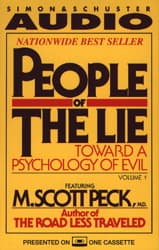

I need to talk about how frustrating it is when a brilliant mind conflates personal distaste with clinical diagnosis. Because that's what kept nagging at me through this ninety-minute listen—Peck is doing something genuinely important here, integrating psychiatric frameworks with spiritual concepts of evil, and then he'll describe someone as "evil" when the evidence sounds more like... a difficult personality? My therapist would have thoughts about this methodology.
But let me back up. I was cooking aloo gobi at 10 PM—one of those nights where my brain wouldn't stop circling a research problem and I needed something to occupy my hands. Peck's voice came through my kitchen speakers, soft but commanding, like a professor who's seen too much but hasn't lost his capacity for wonder. And I found myself standing there, wooden spoon suspended over the pan, genuinely captivated.
When the Psychiatrist Becomes the Preacher
What makes this audiobook compelling is also what makes it maddening. Peck argues that evil exists as a distinct psychological phenomenon—not just mental illness, not just antisocial behavior, but something qualitatively different. How to Hear from God takes a different approach to discerning moral truth, though I found its framework less psychologically rigorous. The people Peck describes hide behind facades of normalcy, projecting their own darkness onto others while maintaining an image of respectability. A fascinating case study in how we conceptualize moral failure through clinical language.
Hearing Peck read his own work adds a layer you wouldn't get from another narrator. His self-assured, reassuring tone makes you want to trust him implicitly. There's an intimacy to author-narrated nonfiction that feels less like being lectured and more like sitting across from someone at their kitchen table. He believes what he's saying. Deeply.
And that's precisely the problem.
The Bias Question (Because We Have to Go There)
The research actually shows that when clinicians have strong emotional reactions to patients, diagnostic accuracy suffers. Peck acknowledges feeling "revulsion" toward some of the people he describes. He's honest about it, which I respect. But then he proceeds to pathologize behaviors that sound—to my ears—like garden-variety dysfunction. Being disorganized and annoying does not make a person evil. Being a difficult parent doesn't either. The messy humanity in Rules Do Not Apply illustrates this perfectly—flawed people making terrible choices without crossing into whatever Peck is trying to define here.
The case studies he presents are vivid, I'll give him that. You can picture these people. But I kept asking: why does Peck classify these individuals as evil rather than, say, narcissistic? Personality disordered? Just... kind of terrible in the way lots of people are terrible? The line he draws feels more theological than clinical, which is fine—he's explicit about integrating religion and psychiatry—but it undercuts the scientific authority he's claiming.
Volume 1 of 3: The Ninety-Minute Appetizer
At just over an hour and a half, you're getting an introduction, not a comprehensive treatment. The brevity works in some ways—Peck stays focused, doesn't meander—but it also means you're left wanting more substantiation for his claims. More case studies. More engagement with counterarguments. More acknowledgment that "evil" is a loaded term he's importing from one discipline into another.
Production is straightforward. No music, no sound effects, just Peck's voice. Clean audio, no technical issues. The simplicity suits the material—this isn't entertainment, it's provocation.
Who Should Press Play (And Who Should Skip)
If you're interested in the intersection of psychology and spirituality, this is essential listening. Peck was pioneering this conversation before it became trendy, and his framework—however flawed—opened doors for subsequent thinkers. If you've read The Road Less Traveled and want more of his integration work, you'll find consistency here.
But if you need rigorous methodology? If you bristle at unfalsifiable claims dressed in clinical language? You'll spend ninety minutes arguing with your speakers like I did. That's not necessarily bad—I learn more from books that irritate me than from books that confirm what I already think. But go in knowing you're getting a provocateur, not a peer-reviewed journal.
Some of this doesn't track psychologically. But the questions Peck raises—about how we define evil, about whether psychiatry has abdicated its responsibility to engage with moral categories, about the people who harm others while maintaining spotless reputations—those questions still matter. Maybe more now than when he first asked them.
My Diagnosis: Flawed But Worth the Session
The aloo gobi burned, by the way. I got too caught up in mentally arguing with Peck's criteria for malignant narcissism. Worth it, though. This is the kind of audiobook that makes you think—not because it's right, but because it's bold enough to be wrong in interesting ways. Peck himself exhibits classic patterns of someone who's seen genuine darkness and maybe overcorrected in his vigilance. I get it. I just wish he'd been more careful with the label.