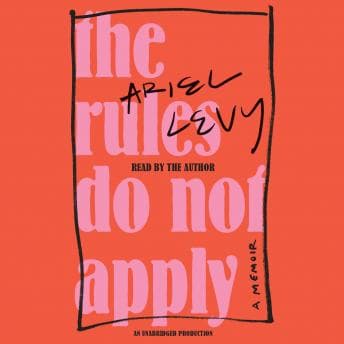

I was supposed to be finishing a logo redesign at 2 AM. Frida was asleep on my keyboard, Diego was judging me from the bookshelf, and I had Ariel Levy's voice in my ears telling me about holding her dying son in a hotel bathroom in Mongolia.
I closed Illustrator. The logo could wait.
When a Writer Reads Her Own Wreckage
There's something almost unbearable about hearing Ariel Levy narrate this memoir. And I mean that as the highest compliment. She wrote these words about losing her baby at 19 weeks, about her marriage dissolving because of her wife's alcoholism and her own affair, about the scaffolding of her "I can have it all" life collapsing—and then she sat in a recording booth and spoke them aloud. The intimacy is almost too much.
Some reviewers call her voice aggressive or harsh. I get it. Levy doesn't soften herself for you. She's not going to hold your hand and whisper comfort. Her delivery is direct, sometimes clipped, occasionally with an edge that made me wince. But here's the thing—that's exactly who she is. This is a woman who built her career on being "too much," too fervent, too forceful. Why would her narration be any different?
The moments where her voice catches—where you can hear her fighting to stay measured while describing the weight of her son in her hands—those moments gutted me. My heart. MY HEART. I had to pause twice during the Mongolia section. Just sat there in the dark with my cats, crying into my cold coffee.
The Beautiful Mess of Wanting Everything
Levy's memoir isn't really about the tragedy, though the tragedy is the earthquake at its center. It's about the fault lines that were already there. She writes about being a young woman in Manhattan, riding the wave of her generation's belief that women could finally have it all—the career, the adventure, the love, the family. She traveled the world for The New Yorker, wrote about fearless women, tried to become one herself.
And then life said: actually, no.
What I love about Levy's honesty is how she refuses to make herself sympathetic. She describes her affair with unflinching clarity. She doesn't ask for forgiveness. She just... tells you. The narrative pacing does get uneven in the second half—she's processing grief in real-time, and grief doesn't follow a three-act structure. Some listeners find this frustrating. I found it devastatingly real.
Abuela would have clutched her rosary at the affair stuff, but she also would have cried with me during the loss. She understood that people are messy. That love is messy. That sometimes the same person can be both the villain and the victim of their own story.
This Book Felt Like a Bruise You Keep Pressing
At just under five hours, this is a one-sitting listen if you can handle it emotionally. (I could not. Took me three sessions and one emergency phone call to my best friend.) The production is clean—no music, no effects, just Levy's voice and her words. It works. Anything else would feel like an intrusion.
The vibes are not cozy. This is not a rainy Sunday book. This is a 2 AM book, a can't-sleep book, a book for when you're ready to feel something sharp and true. Levy yanks your heart around and drops truths that feel like guilty secrets—about ambition, about grief, about the lies we tell ourselves when we think we're invincible.
I ugly-cried at the Mongolia chapter. I ugly-cried when she described going back to work. I ugly-cried at the ending, which doesn't wrap things up neatly because life doesn't do that either.
Who This Is For (And Who Should Maybe Wait)
Listen if you want a memoir that doesn't flinch. If you can handle content about miscarriage, addiction, infidelity, and loss without it triggering your own stuff. If you appreciate a writer who's willing to be the complicated protagonist of her own disaster.
Maybe skip if you need your narrators warm and soothing. Levy's voice has an edge, and if that grates on you, five hours is a long time to be irritated. Also skip if you're looking for resolution—this book ends with Levy beginning again, not triumphant, just... continuing.
The Feels: Raw, Honest, Unforgettable
I finished this book three days ago and I'm still thinking about it. Still thinking about what it means to want too much, to believe the rules don't apply to you, and then to have reality prove otherwise. Levy doesn't offer easy answers. She just offers herself—flawed, grieving, somehow still standing. That kind of raw self-examination—the refusal to perform healing you haven't actually achieved—reminded me of the brutal honesty in Stillness is the Key, though Levy's approach is far less about finding peace and more about surviving the wreckage.
The chemistry between narrator and material is chef's kiss, because they're the same person. You can't separate Levy's words from her voice. That's either going to work for you or it won't. For me, it worked. It worked so well it wrecked me.
Four stars because the pacing wobbles and Levy's voice won't be for everyone. But those four stars? They're earned in blood.