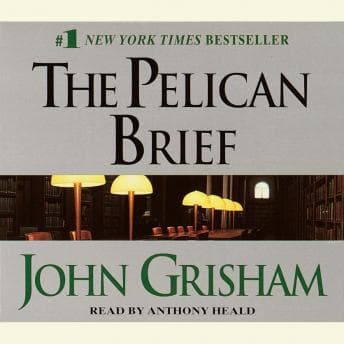

Couldn't sleep last night. Bad habit from deployment days — brain won't shut off, so I grabbed the earbuds and queued up something I'd been meaning to revisit. I read The Pelican Brief in paperback sometime around '93, probably on a flight to Fort Benning, and remembered almost nothing except Darby Shaw and something about pelicans and oil money. Figured it was time.
Let me cut to the chase: this is classic Grisham doing what Grisham does best — a civilian stumbles into something way above their pay grade, powerful people start cleaning house, and the clock starts ticking. It's not his absolute best work, but it's a solid mission with a clear objective and enough twists to keep you locked in.
A Law Student With Better Instincts Than Most Intel Officers
Here's what works. Darby Shaw writes a speculative legal brief connecting two Supreme Court assassinations to an environmental case in Louisiana — a brief that's basically a Hail Mary theory about who benefits from removing two specific justices. The moment that brief lands on the wrong desk in Washington, she becomes a target. What I appreciate is that Grisham doesn't rush to the reveal. You're halfway through before you actually learn what's in the damn brief, and by then the body count has already started climbing. That delayed reveal is smart pacing — it builds tension the way a good intelligence briefing does, giving you pieces without the full picture.
Darby's relationship with her law professor Thomas Callahan is the emotional anchor early on, and when that gets ripped away (violently, in a car bombing that felt uncomfortably realistic), she's operating solo in hostile territory. I've seen this scenario play out in real life — not the assassination conspiracy part, but the feeling of being completely alone with information that could get you killed. Grisham captures that paranoia well. The scenes of Darby on the run through New Orleans, changing hotels, cutting her hair, trusting no one — that's where the book earns its keep.
Heald Finds His Rhythm — Eventually
Anthony Heald narrates, and I'll be honest — the first hour or so felt a little stiff. Like he was reading the book rather than living in it. But somewhere around the time the conspiracy starts heating up, he warms to the material and locks in. His voice carries the right amount of tension during Darby's flight sequences, and his read on Gray Grantham — the Washington Herald reporter who becomes Darby's lifeline — has a good cynical edge to it. Not quite the slick, self-important energy of a real D.C. journalist, but close enough.
The production includes occasional music cues that punctuate the suspense moments. Normally I'd roll my eyes at that — let the story do the work — but here it's subtle enough that it adds atmosphere without getting in the way. Clean audio throughout. No complaints on the technical side.
One thing worth noting: this is an abridged version at 5 hours 30 minutes. The unabridged runs considerably longer. You lose some of the political maneuvering subplots, and a few secondary characters get trimmed. If you're a Grisham completist, that might bug you. For me, the tighter cut actually helped the pacing. Grisham has a tendency to let his Washington scenes drag — all those meetings in the West Wing where staffers talk about optics and damage control. Some of that's gone here, and I didn't miss it.
Where It Shows Its Age
Now, compared to Grisham's best — The Firm, A Time to Kill — The Pelican Brief sits a tier below. The villain's motivation is almost too simple once you get there. An oil tycoon who wants to drill in a Louisiana marshland and needs two justices removed to clear the legal path. It's elegant as a premise but thin as a payoff. And some of the tradecraft feels dated — this is a pre-cellphone, pre-internet thriller, so Darby's using payphones and paper trails. That's not a flaw exactly, but younger listeners might find it quaint.
Some folks apparently found Darby too feisty. I didn't have that problem. She's a law student, not an operator, and she acts like it — scared, improvising, making some dumb moves alongside some brilliant ones. Felt authentic to me.
Worth your time? Here's the debrief: if you want a tight legal conspiracy thriller for your commute and you've already burned through The Firm, this is your next stop. Though I'll warn you — neither of the other candidates in my queue came close to scratching the same itch; Eleven on Top is a lighter animal entirely, fun in its own right but nowhere near the same tension level. Heald delivers a solid performance once he hits his stride, and the abridged format keeps the mission moving. It's not going to change your life, but it'll make that drive to the client site disappear.
Rack It and Move Out
Good audiobook for windshield time. Not Grisham's finest hour, but a reliable operator that gets the job done. Ranger slept through the last hour, but that says more about the hour (0200) than the book. Worth a listen if you catch it on sale — at 5 and a half hours, it's a quick deployment.
Mission accomplished. Mostly.