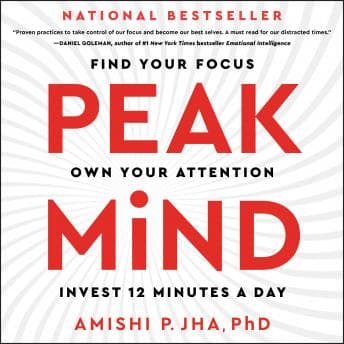

A book about attention that made it genuinely hard to pay attention. Let that sink in for a second.
I started this one at midnight after a brutal day restructuring a client's go-to-market strategy. Brain was fried. Figured a neuroscience book about focus might be the professional equivalent of taking your vitamins. And Dr. Amishi Jha's credentials are no joke - she runs the Mindfulness Research and Practice Initiative at the University of Miami, has done work with military units and first responders on attention training. The science here is real. The 12-minutes-a-day framework is practical. The ROI argument for protecting your attention is solid.
But then there's the audiobook experience itself. And honestly? My 2.0x speed couldn't save this one.
The Irony That Writes Itself
Here's what kills me. Narrator Xe Sands has what multiple listeners describe as a "deep, sexy voice" that "conveys emotion" beautifully. And they're right - she sounds fantastic in isolation. But this is a nonfiction book about cognitive science, and her cadence and pacing are calibrated for something closer to a literary novel or a memoir. The result is a narration style that actively fights the content. You're trying to absorb Jha's explanations of attentional subsystems and working memory, and the delivery keeps lulling you into a different headspace entirely.
It's like hiring a jazz pianist to play your corporate earnings call background music. Technically excellent. Completely wrong context.
I caught myself rewinding sections three, four times - not because the material was dense (it is, but manageable), but because the narration rhythm kept pulling my focus somewhere else. For a book whose entire thesis is that we lose 50% of our lives to wandering attention, this is... not ideal. Jenny would say I'm being harsh. Jenny is right. But also, Jenny would agree that if you hire a personal trainer who keeps making you sit down, something's off.
What Your Brain Actually Needs (The Good Stuff Inside)
Strip away the delivery issue and Jha's actual framework deserves respect. The core argument: your attention isn't broken, it's untrained. She breaks attention into three systems - a flashlight (focus), a floodlight (awareness), and a juggler (executive function) - and walks through how mindfulness practices can strengthen each one. The 12-minutes-a-day protocol is refreshingly modest. No guru nonsense, no "unlock your infinite potential" garbage. Just: here's what the research shows, here's the minimum effective dose, here's how to start. The anti-hype honesty here reminded me of what I appreciated in You Were Not Born to Suffer - another wellness title that at least tries to ground itself in something real rather than aspirational noise, even if the execution doesn't always hold up.
This is what my parents did instinctively. Now it has a TED talk. My mom running that dry cleaning counter for 14 hours straight, tracking every ticket, every customer, every pressing cycle - that wasn't talent, that was trained attention born from necessity. Jha's research basically validates what immigrant small business owners have been doing without a neuroscience degree.
The key takeaway is worth the listen. The other 7 hours? Not so much. There's significant padding - anecdotes that overstay their welcome, research summaries that could be tighter. At 9.5 hours, this book is probably 4.5 hours of genuine insight stretched to fill a publishing standard. There's a supplemental PDF included, which is where the actual exercises live. Smart move, but it also tells you something about how much of the audio is setup versus payoff.
Who Gets the Invoice and Who Gets a Refund
If you're a founder, a consultant, anyone whose livelihood depends on sustained cognitive performance - the content here is legitimately useful. I've seen attention management (or the lack of it) kill productivity at three different companies. Jha gives you science-backed tools instead of productivity-porn platitudes.
But the audiobook format specifically? That's where I hesitate. The narration mismatch turns a focused read into a wandering listen. You'd honestly get more from the print or ebook version, where you control the pacing yourself. If audio is your only option, bump the speed to at least 1.5x - it actually helps counteract the slow, emotive cadence and keeps the information delivery closer to where your brain wants it for nonfiction absorption.
Skip this one on Audible credits. Grab it from the library - Libby, Hoopla, whatever your system is. The ideas are worth your time. The specific audio production isn't worth your money.
The Consulting Engagement Summary
Bottom line: Solid science, practical framework, wrong narrator for the job. Jha's 12-minute attention protocol is the most honest self-help prescription I've heard in months - no hype, just data. But an audiobook about focus that undermines your focus is a product-market fit problem I can't ignore. Read the book. Skip this recording.