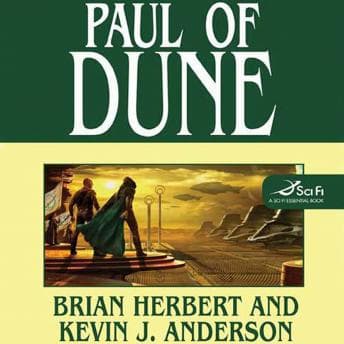

Frank Herbert's Dune Messiah is a jarring context switch from the original book. One minute Paul is the hero; the next, he's a tired emperor with a galaxy-burning problem. Paul of Dune attempts to refactor that transition, acting as the middleware between the two novels. I listened to this during a week of signal delays on Caltrain, which felt appropriate—Paul is essentially stuck in a holding pattern between being a rebel hero and a galactic tyrant.
THE "INTERQUEL" ARCHITECTURE
This isn't Frank Herbert's code. Let's get that out of the way immediately. Frank wrote dense, philosophical stack traces on ecology and religion. Brian Herbert and Kevin J. Anderson write action-adventure scripts. It's like comparing C++ to Python—this is much easier to parse, but you lose the memory management and depth. The story tracks Paul's Jihad in full swing, specifically his internal struggle: "Am I going mad? Has the Jihad escaped my control?" It answers the logistics of how he built the empire, but it lacks the subtle menace of the original. It's a 19-hour patch note explaining a version update that purists might argue didn't need explaining.
Brian Herbert takes a similar approach in Dune: House Harkonnen—filling in backstory that Frank left deliberately sparse, with the same tradeoff of accessibility over depth.THE SCOTT BRICK FACTOR
Scott Brick is the Vim of narrators—people either swear by his efficiency or can't stand his interface. The research calls his performance "theatrical," which is code for "he reads every sentence like it's the final line of a Shakespearean tragedy." In a contemporary thriller, this can be exhausting. But here? In a space opera about a god-emperor grappling with infinite foresight? It works.
He has this specific, breathy cadence for Paul's internal monologues that clearly separates them from spoken dialogue. You never wonder if Paul is thinking about betrayal or actually accusing Stilgar of it. Brick leans hard into the "Great One-Man Show" energy, giving the aristocratic characters a distinct edge compared to the rougher Fremen tones. If you're sensitive to melodramatic narration, check the sample first. He doesn't dial it back.
Scott's the same way in Black Ops—full commitment to the material, no apologies, and it either locks you in or kicks you out in the first chapter.WHO'S THIS BUILD FOR?
Completionists who need every gap in the Dune timeline filled will appreciate the 19-hour deep dive into Jihad logistics. Skip it if you're a Frank Herbert purist who considers the expanded universe non-canonical bloat—the prose shift will irritate you constantly.
CLOSING THE LOOP
If you finished the first book and felt like Messiah skipped too many steps, this fills the buffer. It's not essential reading, and the prose can be clunky compared to Frank's, but it's functional. It explains the "how" of the Jihad, even if it misses the "why" of the philosophy.