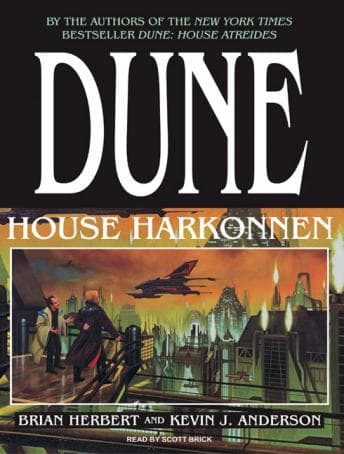

Twenty-seven hours of political scheming, spice economics, and Harkonnen brutality. I listened to this entire thing instead of writing my thesis chapter on procedural generation in roguelikes. Dr. Patel would be disappointed. I regret nothing.
Look, I'm going to be honest with you—this is not Frank Herbert's Dune. But you knew that walking in. What Brian Herbert and Kevin J. Anderson deliver here is something different: a sprawling, almost D&D campaign-level expansion of the Dune universe that fills in gaps you didn't know you wanted filled. The magic system—sorry, the political system—is *chef's kiss* in its complexity. We're talking wheels within wheels within wheels, and Scott Brick is your dungeon master for all of it.
The Harkonnen Problem (And Why It Works Anyway)
Here's the thing that frustrated me at first: the Harkonnens in this book are cartoonishly evil. Like, we're talking "kick the dog" moments every time Vladimir or Rabban shows up on the page. There's no subtlety. No nuance. Just pure, uncut villainy that would make my D&D group's murder hobos look like paladins.
But somewhere around hour twelve—I was making boxed mac and cheese at 2 AM because thesis stress hits different—I realized that's kind of the point? This is Sanderson-level world-building in terms of scope, even if it lacks some of the original's philosophical depth. Shadow of Night does something similar with its sprawling historical scope, though it trades political intrigue for time-travel mechanics. Herbert and Anderson are painting in broad strokes because they're covering DECADES of history across multiple planets and noble houses. You don't get the intimate character work Frank gave us with Paul. You get a sweeping historical epic where the bad guys are bad and the good guys are... well, complicated.
Leto Atreides spends most of this book being complacent, which is honestly refreshing? He's not a hero yet. He's a duke who inherited power young and doesn't fully understand the game being played around him. That progression is satisfying in a way I didn't expect.
Scott Brick Walked So Other Dune Narrators Could Run
This man has won like forty AudioFile Earphones Awards and two Audies for his Dune work, and yeah, you can hear why. His voice for Baron Harkonnen has this oily, self-satisfied quality that made my skin crawl in the best way. The Bene Gesserit sisters get this controlled, almost musical precision in their speech. Leto sounds young and earnest in ways that hurt knowing what's coming.
Are there moments where the pacing drags? Absolutely. Some of the political exposition gets dense, and Brick's measured delivery doesn't always help scenes that already feel like reading a textbook on Imperial economics. If you're listening at 1x speed during a long commute, you might zone out during the Spacing Guild negotiations. (I did. Twice. Had to rewind.)
But when the action hits? When the schemes start collapsing and characters start dying? Brick delivers. His emotional range during the tragedy scenes—and there are several—actually got me choked up while I was supposed to be debugging a pathfinding algorithm.
This Is 40 Hours Combined (Yes, It's Worth It)
If you're jumping into House Harkonnen without reading House Atreides first, you're going to be lost. This is book two of a prequel trilogy, and it assumes you know who everyone is and what's happening with the artificial spice project. The scene-hopping can feel jarring—we'll be with Leto on Caladan, then jump to Arrakis, then to Giedi Prime, then to the Imperial court—and if you're not locked in, you'll lose the thread.
This is NOT a background listening audiobook. Put it on while doing dishes and you'll miss crucial plot points. This demands focus time. I listened during late-night coding sessions when I needed something engaging enough to keep me awake but not so demanding that I couldn't debug simultaneously. Worked perfectly for that.
Who Should Pledge Their Sword to This House
If you've read Frank Herbert's original and want MORE—more politics, more history, more understanding of how we got to Paul's story—this delivers. If you're the kind of person who reads Wookieepedia articles for fun or spends hours on the Coppermind wiki, you're going to love this expanded universe content.
If you want the philosophical density of the original Dune? If you need your villains complex and your prose literary? Skip this. You'll be frustrated.
My D&D group would absolutely love this as campaign inspiration. The noble house politics, the secret societies, the long-game scheming—it's all prime material for a political intrigue campaign. I've already stolen the Bene Gesserit breeding program concept for a faction in my homebrew setting.
Roll for Initiative, House Atreides
Is this a genre-defining achievement? No. Is it a 27-hour commitment that pays off if you're already invested in the Dune universe? Absolutely. Scott Brick's narration elevates material that could feel like fan fiction into something genuinely engaging. The world-building is expansive even when the character work is thin. The political machinations are satisfying even when the villains are one-dimensional.
I finished this at 4 AM on a Tuesday. My thesis remains unwritten. The Stormlight Archive audiobooks are calling to me. But I don't regret a single hour spent in the desert. The spice must flow, and apparently so must my procrastination.