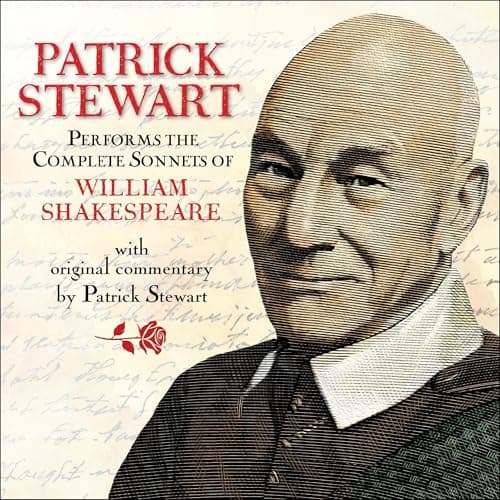

Everyone told me this was going to be the definitive Shakespeare sonnets recording. Every literary podcast, every colleague in the English department, every corner of the internet where people still care about iambic pentameter. And here's the thing - they're not wrong. But they're also underselling what Patrick Stewart actually did here, which is something stranger and more generous than just "reading Shakespeare really well."
I finished the last sonnet walking the lakefront with Denise on a Sunday morning, fog sitting heavy on the water, and she asked why I'd gone quiet. I didn't have a good answer. I was just sitting with Sonnet 73 - "That time of year thou mayst in me behold" - and the way Stewart had let the final couplet land like a stone dropping into still water. No rush. No actor-y emphasis. Just the words, and then silence, and then his own reflection on what those words had meant to him across forty-plus years of performing Shakespeare. That pause between the poem and the commentary? The narrator understands that pause is punctuation.
What Stewart Does That Your Norton Anthology Can't
Let me be specific about the structure, because it matters. This isn't just 154 sonnets read end to end. Stewart intersperses personal commentary between poems - sometimes a few sentences, sometimes longer reflections on a particular word choice or the emotional arc he sees running through a sequence. He'll stop after Sonnet 18 ("Shall I compare thee to a summer's day") and talk about how many times he's performed it, how his understanding shifted over decades, what he now hears in "temperate" that he missed at twenty-five.
This is why we still read the classics. Not because the words are sacred and untouchable, but because a human being with seventy years of living behind them hears something different in "Shall I compare thee" than a twenty-year-old does. Stewart makes that audible. He's not lecturing. He's thinking out loud, and you're invited to listen.
At 3 hours and 47 minutes, you're getting all 154 sonnets plus substantial commentary, which means the pacing is brisk but never rushed. Each sonnet gets its full weight. Stewart's voice - that deep, warm British instrument that half the world associates with starship captains and Christmas spirits - carries an authority that never tips into pomposity. He reads at what I'd call a "trust the language" pace. The prose deserves to be savored, and Stewart knows it.
The Pandemic Readings Grew Up
Some of you might remember Stewart posting daily sonnet readings during lockdown, sitting in his living room, looking slightly bewildered by a phone camera. Those were lovely but rough - charming in their spontaneity, uneven in their delivery. These new recordings are the refined versions. You can hear the difference. There's an intentionality to his breath control, a precision in how he handles the volta (that turn in a sonnet where the argument shifts). In Sonnet 129 - "Th' expense of spirit in a waste of shame" - he builds the frantic, tumbling momentum of Shakespeare's syntax about lust with this barely controlled energy that's genuinely thrilling, then pulls back for the devastating quiet of the closing couplet.
My students would hate this. I love it.
Not because it's inaccessible - actually the opposite. Stewart's commentary acts as a bridge for listeners who find Shakespeare intimidating. He doesn't dumb it down. He contextualizes. He wonders aloud. He admits confusion sometimes, which is the most honest thing a Shakespeare performer can do. If you loved his memoir "Making It So," this is its spiritual successor - the same candor, applied to material he's lived inside for decades. That kind of candor from someone deep inside their craft reminded me of Hank Haney's Big Miss: My Years Coaching Tiger Woods - different world entirely, but the same thing happens where an insider reflects on greatness up close and you end up learning more about the reflector than you expected.
The Quiet Limitation
I'll say this: if you want scholarly annotation, historical context about the Fair Youth and the Dark Lady, debate about publication order - you won't get much of that here. Stewart's commentary is personal and performative, not academic. He's an actor reflecting on craft, not a professor building an argument. For some listeners that's exactly right. For others it might feel like you're getting feeling without enough framework. I teach Shakespeare. I wanted him to dig into the biographical mysteries a bit more. But then he'd read another sonnet and I'd forget I was disappointed.
Also - and this is minor - there's no music, no sound design, nothing but Stewart's voice and silence. For poetry, I think that's the correct choice. But if you're used to produced audiobooks with atmospheric layering, the starkness might catch you off guard.
Who Should Listen (And Who Should Skip)
If you love Shakespeare but have never quite known what to do with the sonnets on the page, this is your way in. If you're already a sonnets devotee, Stewart's personal commentary will give you new angles on poems you thought you'd exhausted. Skip it if you need academic rigor and historical scaffolding - this is an actor's reading, not a lecture series.
Worth Pausing the Faculty Meeting For
Let's talk about what the author is really saying - or rather, what Stewart helps you hear. Shakespeare's sonnets are about time, desire, beauty, jealousy, aging, and the desperate hope that language can outlast all of it. Stewart is 84 years old. When he reads "Against my love shall be as I am now, / With Time's injurious hand crushed and o'erthrown," you're hearing a man who understands that in his bones, not just his training. That's what makes this recording different from every other complete sonnets collection. It's not the best voice reading Shakespeare. It's the right voice, at the right time, with the right weight of lived experience behind every line.
I listened at 1.0x. Obviously. The author chose those words, and Stewart chose exactly how to deliver them. Speed this up and you lose everything that makes it matter.