
I teach Hemingway every year. The Sun Also Rises, A Farewell to Arms, the short stories—I've read them so many times I can quote the iceberg theory in my sleep. But here's what twenty years of teaching Papa never prepared me for: actually liking the guy less after understanding him better.
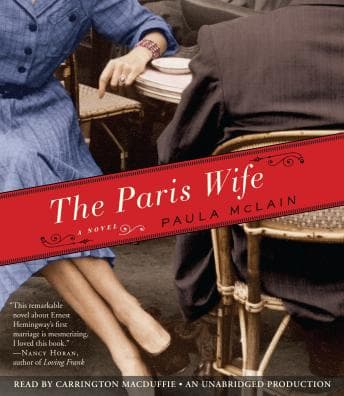
Paula McLain's novel hit me somewhere unexpected. I was grading papers at 11 PM—my usual audiobook hour—and Carrington MacDuffie's voice was doing something I didn't anticipate. She made me feel sorry for Hadley Richardson. Not in a pitying way, but in that gut-level recognition of watching someone love harder than they're loved back.
The Woman Behind the Legend
Look, I've spent years telling students about the Lost Generation. Gertrude Stein's salon, the cafes of Montparnasse, the beautiful chaos of 1920s Paris. It's all very romantic from a literary distance. But McLain does something clever here—she takes all that glamour and shows you the invoice. The Midnight Library does something similar—stripping away the fantasy to show what regret actually weighs. The actual cost.
Hadley's perspective is devastating because she's so reasonable. She's not dramatic. She's not demanding. She watches her husband become Ernest Hemingway—the legend, the brand—and you can feel her trying to hold onto the Ernest she married. The one who needed her. MacDuffie captures this with a gentleness that honestly made me pause my grading more than once. Her voice has this quality of someone remembering something painful but precious. Warm, but with an edge of knowing how the story ends.
My students would probably find the pacing slow. There are stretches where not much happens—it's mostly Hadley observing, waiting, hoping. But that's the point, isn't it? That's what being a writer's wife in that era meant. You were the audience for someone else's becoming.
When the Narrator Disappears Into Hadley
MacDuffie doesn't try to do elaborate character voices, and honestly? Thank God. Nothing kills historical fiction faster than a narrator doing a bad Fitzgerald impression. Instead, she shifts her tone subtly—a little more clipped for Hemingway's dialogue, a bit breathy for the Parisian social scenes. It works because it keeps you grounded in Hadley's experience. Everyone else is filtered through how she perceives them.
There's a restraint to the performance that mirrors Hadley herself. Even in the scenes where you want to shake her—where Pauline Pfeiffer starts circling like a shark in a Chanel dress—MacDuffie doesn't lean into melodrama. She lets the betrayal unfold quietly. Which, if you know anything about how Hemingway actually left Hadley, is exactly right. It wasn't explosive. It was erosion.
The narration occasionally felt a touch flat during some of the more formal party scenes. When everyone's being witty and literary, I wanted a bit more spark. But that's a minor complaint. For eleven and a half hours, MacDuffie kept me company through one of the saddest love stories I've encountered in years.
Why We Still Read About These People
Here's what I kept thinking about while walking the lakefront with Denise last weekend, still processing this book: we teach Hemingway because of the prose. The clean sentences, the masculine minimalism, the whole mythology. But McLain's novel asks a different question. What did that cost? Who paid for it?
The answer, apparently, was Hadley. And their son Bumby. And whatever version of himself Ernest might have been if he'd chosen differently.
I'm going to recommend this to my AP Lit students before we start The Sun Also Rises next semester. Not as a supplement—as a counterweight. Because understanding that Jake Barnes and Lady Brett were born from the wreckage of an actual marriage changes how you read them. It should.
If you loved A Moveable Feast (Hemingway's own nostalgic version of these years), this is its shadow self. The same story, told by the person who didn't get to write the history. McLain gives Hadley that voice. MacDuffie makes sure you hear it.
Who This Is (and Isn't) For
If you're a Hemingway devotee curious about the woman behind the early work, or you love literary historical fiction that prioritizes emotional truth over plot, this one's for you. Skip it if you need fast pacing or find slow-burn character studies tedious—my students would probably bail by hour three.
Last Bell
This isn't a fast listen. It's not trying to be. It's the kind of book that rewards patience—the prose deserves to be savored, and MacDuffie paces it accordingly. I listened at 1.0x because rushing felt wrong. Like skipping through someone's memories.
Would I listen again? Probably not soon. It's too melancholy for repeat visits. But I'm genuinely glad I spent those eleven hours with Hadley Richardson. She deserved a witness. And now, a century later, she finally has one.