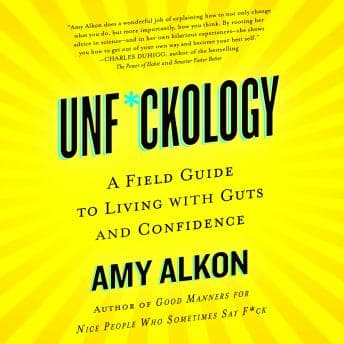

I was halfway through a batch of chana masala — the kind that takes an hour because I insist on toasting whole spices like my grandmother taught me — when Amy Alkon told me that thinking my way into behavioral change is basically the psychological equivalent of rearranging deck chairs on the Titanic. I put down my spatula. Because she's not wrong.
Alkon's central thesis in Unfckology* is one I've been circling around in my own research for years: cognition-first approaches to changing behavior are wildly overrated. The research actually shows that embodied cognition — the idea that your body and your actions shape your mental states just as much as the reverse — has serious empirical backing. And Alkon, to her credit, doesn't just wave at the science and move on. She pulls from evolutionary psychology, neuroscience, and clinical work to build an argument that's surprisingly coherent for a book with an asterisk in the title.
When Your Self-Help Book Has an Actual Literature Review
Here's what I wasn't expecting: Alkon cites real researchers. Not in a "studies show" handwave way, but actually naming names, discussing experimental designs, walking through findings from people like Antonio Damasio and Albert Bandura. As someone who's read approximately nine thousand self-help books that cite "a Stanford study" without ever telling you which one, this felt like a cold glass of water in a desert of pseudoscience.
The core framework goes like this: fear isn't something you think your way out of. You behave your way through it. Alkon calls this "science-help" rather than self-help, and while part of me finds the branding a little cute, the substance backs it up. She argues that targeting fears with deliberate behavioral exposure rewires habitual emotional responses — which is basically exposure therapy repackaged for a general audience, but she does it well. The mind-is-bigger-than-the-brain concept she keeps returning to isn't new to anyone who's read embodied cognition literature, but she makes it accessible without dumbing it down. That's harder than it sounds.
What makes this book compelling is what it doesn't do. It doesn't tell you to stand in front of a mirror and recite affirmations. It doesn't promise that positive thinking will manifest your best life. Alkon is openly hostile to the self-esteem industrial complex, and as someone who's written a paper (that nobody read, naturally) on how inflated self-esteem correlates with narcissistic trait expression rather than actual competence — I found myself nodding along aggressively while stirring cumin seeds.
Carrington MacDuffie Gets the Assignment
The narration here is doing real work. Carrington MacDuffie reads Alkon's text with exactly the right amount of sardonic bite. There's a gruffness to her delivery when Alkon is dismantling bad science, and a conspiratorial enthusiasm when she's building up to a punchline. The comedic timing is genuinely good — there were moments where I laughed out loud, alone in my kitchen, like a person who has made peace with her life choices.
This is nonfiction, so there aren't distinct character voices to evaluate. But MacDuffie modulates her tone enough that eight hours doesn't feel monotonous. The sarcasm lands without feeling performed, which is a narrow needle to thread. She sounds like she agrees with Alkon, like she's a co-conspirator rather than just a voice reading words. That energy matters in a book this opinionated.
Where My Inner Researcher Got Twitchy
I do have quibbles. Psychologically, some of this tracks better than others. Alkon's evolutionary psychology sections occasionally lean into just-so stories — the kind where you explain current behavior by inventing a plausible ancestral scenario and calling it a day. The field has real findings, but it also has a tendency toward unfalsifiable narrative, and Alkon doesn't always distinguish between well-supported evo-psych claims and speculative ones. I found myself asking: does she know the difference, or is she just picking the studies that support her argument?
Also — and this is a me problem — the tone occasionally tips from "irreverent" into "trying really hard to be irreverent." The f-bombs are part of the brand, I get it. But there's a diminishing returns curve on profanity as punctuation, and by hour six I'd sort of stopped registering them.
But these are minor complaints in a genre where the competition is literally telling you to visualize success while the universe delivers it to your doorstep. Rich Dad Poor Dad is a good example of the genre at its most frustratingly anecdote-heavy — confident, quotable, and light on the kind of mechanistic reasoning that would let you actually evaluate the claims.
Who Needs This (and Who Doesn't)
If you're the kind of person who's read twelve self-help books and still feels stuck — and especially if you suspect the reason is that those books were all vibes and no science — this is worth your time. If you want someone to validate your feelings and tell you you're already perfect, Alkon is absolutely not your girl. She's more of a "get up and do the scary thing, here's the neuroscience explaining why that works" kind of author.
Skip it if you want academic rigor at the journal-article level. This is pop science, and it knows it. But it's good pop science, which is rarer than it should be.
My Therapist Would Approve of This Prescription
I came into this expecting to be annoyed. A self-help book with a swear word in the title? My expectations were subterranean. But Alkon surprised me. She understands that the mind isn't a disembodied computer — it's a whole system, body included — and she builds practical advice on that foundation. The protagonist here (because yes, in a self-help book, you are the protagonist) exhibits classic avoidance patterns that Alkon systematically dismantles with a combination of research and dark humor. My therapist would have thoughts about recommending this to clients. Mostly positive ones, I think.
Is it perfect? No. Is it the best science-informed self-help audiobook I've listened to while accidentally burning cumin? Yes. And that's a more competitive category than you'd think.