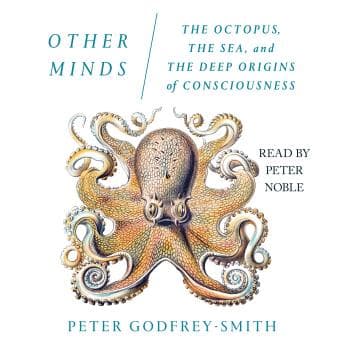

"The octopus is the closest we will come to meeting an intelligent alien."
That line hit me somewhere around hour two, while I was standing in my kitchen stirring a dal that was threatening to burn because I'd stopped paying attention to anything except Peter Godfrey-Smith's argument about convergent evolution of consciousness. I turned the burner off. The dal could wait. This couldn't.
When Evolution Builds a Mind Twice
Here's what kept me up that night, long after the audiobook ended: the octopus and the human share a common ancestor from roughly 600 million years ago. That ancestor was — and I'm being generous here — basically a flatworm. No brain to speak of. No complex behavior. And yet, from that unpromising starting point, two entirely separate lineages independently evolved something we'd recognize as intelligence, as subjective experience, as mind.
I found myself asking: why does this feel so destabilizing? And I think it's because we've built our entire framework of consciousness studies around the mammalian brain. We assume a certain architecture — cortex, hippocampus, the whole centralized command structure. The octopus throws all of that out. Two-thirds of its neurons are in its arms. The arms can taste, can make decisions, can explore independently while the central brain does something else entirely. Godfrey-Smith describes watching an octopus reach one arm into a crevice while its eyes — and presumably its attention — are focused elsewhere. That's not just a different kind of intelligence. That's a different topology of selfhood.
Psychologically, this doesn't track with anything we assume about unified consciousness. And that's exactly why it matters.
The Philosopher Who Gets His Hands Wet
What makes Godfrey-Smith so effective here is that he's not just synthesizing research from a library carrel. He's a scuba diver. He's been to Octopolis — yes, that's what they actually call it — a site off the coast of Australia where octopuses have abandoned their typical solitary existence and started living in proximity to each other, interacting, even fighting over dens made from scallop shells. The descriptions of his dives are where the book breathes. You get the murky visibility, the patience of sitting on the ocean floor waiting for an octopus to decide you're boring enough to ignore, and then — the moment of contact, when one reaches out and wraps an arm around your hand, suckers tasting your skin.
The protagonist — and yes, I'm calling Godfrey-Smith a protagonist, this is a fascinating case study in the scientist-as-narrator — exhibits classic intellectual humility. He doesn't oversell. When the evidence is ambiguous, he says so. When the question of whether octopuses have subjective experience hits a wall, he sits with the uncertainty rather than bulldozing through it with claims he can't support. The research actually shows that this is rare in popular science writing. Most authors pick a thesis and then cherry-pick their way to a conclusion. Godfrey-Smith follows the evidence into uncomfortable ambiguity, and I respect the hell out of that.
Peter Noble Knows How to Read a Philosopher
Peter Noble's narration has this steady, unhurried quality that matches the book's pace — which is deliberate, contemplative, occasionally dense. He doesn't try to inject drama where there isn't any. When the text shifts from philosophical argument to underwater observation, his delivery warms slightly, opens up. It's subtle. He treats Godfrey-Smith's prose like what it is: the work of someone who thinks carefully about every sentence. No vocal fireworks, no unnecessary affect. Just clarity and a kind of quiet attentiveness that made me trust him as a guide through some genuinely complex material about neural evolution and the hard problem of consciousness.
I heard that same steady intelligence in his work on Promise—a novel whose emotional weight needs a narrator who never pushes, just stays present.At seven hours, it's the right length. Long enough to be substantive, short enough that it doesn't pad. I will say: this is not background listening. I tried it on a morning jog through Cambridge and had to restart a twenty-minute section because I'd been too focused on not slipping on ice to process the argument about distributed nervous systems. This book demands your full brain. (My therapist would have thoughts about why I find that appealing rather than exhausting.)
That same pull toward demanding introspection is something I felt all the way through When Panic Attacks, which reframes anxiety as a map of the mind rather than an enemy.Who This Is Really For — And Who Should Swim Away
If you want a breezy animal facts book, this isn't it. If you want to feel smarter without doing any cognitive work, wrong audiobook. But if you've ever lain awake wondering what it would feel like to have a mind organized around fundamentally different principles — if the question "what is it like to be something else?" genuinely keeps you up — then this is your book. Philosophy of mind people, psych nerds, anyone who's ever looked at an animal and wondered what's happening behind those eyes.
I came away thinking differently about consciousness itself. Not as a thing you have or don't have, but as a spectrum that nature has explored through wildly different architectures. The octopus didn't just evolve intelligence. It evolved a completely alien version of what it means to have an inner life.
That dal, by the way? Turned out fine. Some things benefit from sitting a while.





![Steve Jobs [unabridged audiobook] audiobook cover](/_next/image?url=https%3A%2F%2Fcovers.audiobooks.com%2Fimages%2Fcovers%2Ffull%2F9788499923406.jpg&w=1920&q=75)