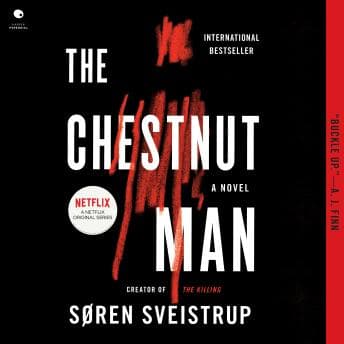

Look, I have a confession. I'm deeply suspicious of anything that gets adapted into a Netflix series before I've had a chance to form my own opinions. It's a thing. My therapist says it's about control. She's probably right.
But here's the thing about The Chestnut Man: I listened to it during a particularly brutal February, jogging through Cambridge at 6 AM when the frost made everything look like a crime scene anyway. And Søren Sveistrup—the guy who created The Killing—understands something fundamental about human psychology that most thriller writers miss entirely. He knows that the scariest monsters aren't the ones hiding in shadows. They're the ones who believe, with absolute conviction, that they're doing the right thing.
The Psychology of a Signature
Those chestnut dolls. Let's talk about them.
A serial killer's calling card is never random. It's communication—a desperate, twisted attempt at connection. The research on criminal signatures shows they're often rooted in childhood trauma, a way of recreating or rewriting a formative experience. Sveistrup gets this. The chestnut man isn't just creepy set dressing (though it absolutely is that too). It's a window into a fractured psyche.
What makes this particularly fascinating from a psychological standpoint is how the fingerprint discovery—a dead girl's print on a doll at a new crime scene—functions as both plot mechanism and character study. It forces the detectives (and us) to question everything we thought we knew about a closed case. The protagonist exhibits classic cognitive dissonance when confronted with evidence that contradicts their worldview. Watching that dissonance resolve? That's where the real tension lives.
I found myself asking: why does this killer need to be seen? Because make no mistake, leaving signatures is about being witnessed. It's not enough to commit the act. Someone must understand.
Peter Noble Earned That Audie
His delivery is measured in a way that perfectly captures Nordic noir's particular brand of bleakness. There's this restraint in his voice that somehow makes the violence hit harder. He's not sensationalizing anything. He's just... presenting it. Like a clinical psychologist reading case notes. (I would know.)
The character differentiation is solid—especially the gruff detective voice, which could've easily slipped into parody but never does. Noble keeps everyone distinct without turning it into a voice acting showcase. The atmosphere he creates is genuinely frigid. I was shivering on my jogs and I'm pretty sure it wasn't just the weather.
Some listeners found him "robotic." I don't agree, but I understand where they're coming from. His restraint might read as coldness if you're used to more emotionally demonstrative narrators. And the Danish names—Thulin, Hess, Genz—do pile up. I lost track of a few secondary characters early on. But honestly? Minor complaint for 15 hours of otherwise gripping audio.
A Note on the Darkness
I need to be direct: this book contains child abuse. Not gratuitously—Sveistrup isn't exploiting trauma for shock value—but it's there, and it's central to the plot. If that's a hard line for you, respect that boundary. Skip this one.
For everyone else, what Sveistrup does with that darkness is actually quite sophisticated. He's examining how trauma ripples outward, how it corrupts institutions, how the people meant to protect children sometimes become complicit in their suffering. The government minister character—whose daughter was the original victim—is a fascinating case study in public grief versus private guilt. The author understands human nature in ways that make me uncomfortable. In a good way.
The pacing is deliberate. This is a slow burn that earns its runtime. Four Blind Mice has that same deliberate pacing—it trusts you to stay with the investigation even when the answers don't come easy. There were moments during my morning runs where I'd extend my route just to hear what happened next—and then moments where I'd slow to a walk because I needed to process what I'd just heard. That's effective psychological suspense.
The Right Listener for This One
If you're into Nordic noir—Stieg Larsson, Jo Nesbø, that whole genre—this is a must-listen. The atmosphere is pitch-perfect, the psychology is sound, and Noble's narration elevates already strong material. If you need your thrillers fast and punchy, sample first. This one takes its time. It trusts you to sit with discomfort. And if you're sensitive to violence against children, even when handled thoughtfully, read the content warnings and make your own call. No judgment.
I listened at 1x speed, which I almost never do for thrillers. But the atmosphere demanded it. Sometimes you need to let the cold seep in.