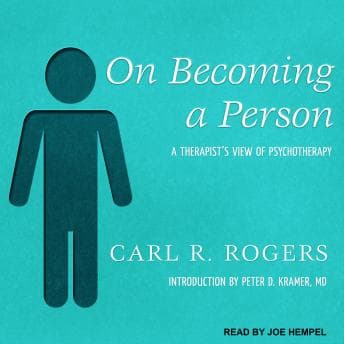

What does it actually mean to help another person become more fully themselves?
I was stirring a pot of dal at midnight—one of those elaborate cooking projects I do alone, half-distracted—when Carl Rogers asked this question. And I had to put down the wooden spoon. Because here's the thing: I've read *about* Rogers in countless textbooks, cited him in papers, absorbed his ideas through the osmosis of graduate school. But I'd never actually sat with the man's own words for fourteen hours.
The research actually shows that most psychology students know Rogers the way they know Freud—as a historical figure, a name attached to concepts. "Client-centered therapy." "Unconditional positive regard." We learn the vocabulary without experiencing the thinking behind it. This audiobook is the thinking behind it.
The Radical Simplicity of Actually Listening
Rogers writes like a man who has spent decades in rooms with suffering people and emerged with one conviction: humans are fundamentally trustworthy. The protagonist of his worldview—and yes, I'm treating this like a case study—exhibits classic counter-cultural positioning. In an era of psychoanalysis and behaviorism, both of which treated patients as problems to be decoded or conditioned, Rogers proposed something almost embarrassingly simple. What if we just... believed people?
What makes this compelling is how uncomfortable it made me. I found myself asking: why does this feel naive? I'm a researcher. I study why people do terrible things to each other. And here's Rogers, arguing that given the right conditions—empathy, genuineness, acceptance—people naturally move toward growth. My therapist would have thoughts about my resistance to this idea.
The book rambles. I won't pretend otherwise. Rogers includes role-play transcripts that, by the fifth or sixth example, feel redundant. You get the point. You got the point three transcripts ago. At 1.25x speed (which I'd recommend), these sections become more tolerable, but there's a reason some listeners call this book repetitive. It is. Rogers was a therapist, not an editor.
Joe Hempel's Steady Presence
Here's where I have to be honest about what I don't know. The research doesn't give me much on Hempel's specific vocal choices—no details about how he handles Rogers' more philosophical passages versus the clinical examples. What I can tell you is that listeners consistently describe him as "easy to listen to" with a "nice presentation," which is faint praise that actually means something over fourteen hours.
This isn't a performance-driven audiobook. Hempel isn't doing character voices or dramatic readings. He's presenting academic material with clarity, and for a book this dense, that's exactly what you need. I listened during morning jogs through Cambridge and while cooking, and his pacing never made me lose the thread. The production is clean. The audio is professional. It's workmanlike in the best sense—the narrator disappears, and Rogers remains.
The Uncomfortable Mirror
What I wasn't prepared for was how personal this would feel. Rogers writes about the conditions for psychological growth, and those conditions apply to therapists, teachers, parents, friends. Anyone who wants to help another person become. And he's essentially saying: you can't fake it. You can't technique your way into genuine connection.
This is a fascinating case study in vulnerability from a professional. Rogers admits his failures. He describes sessions where he couldn't be present, where his own defenses got in the way. For a founder of a major psychological movement, he's remarkably humble about the limits of his own humanity.
Psychologically, this tracks. The research on therapeutic effectiveness consistently shows that the relationship matters more than the technique. Rogers knew this in 1961. We keep rediscovering it.
Who Needs This (And Who'll Be Frustrated)
If you're a psychology student who's only encountered Rogers through secondary sources, this is essential. Hear the man think. If you're a therapist, counselor, or anyone in a helping profession, the core chapters on the therapeutic relationship are still relevant sixty years later.
But if you want a tight, edited, practical guide? This isn't it. Rogers meanders. He includes conference papers and research summaries that feel dated. The role-play transcripts, while illustrative, become repetitive. Skip this if you need actionable steps or can't tolerate academic pacing—this is a book that rewards patience and punishes skimming.
I'd recommend 1.25x speed for most sections. Some listeners suggest 2x for the research-heavy chapters, but I found that too fast for material this conceptually dense.
What My Dissertation Committee Would Say
They'd say I'm being too generous. That Rogers' optimism about human nature doesn't account for structural violence, for trauma that breaks people in ways empathy can't fix, for the limits of individual therapy in a broken world.
And they'd be right. But they'd also be missing the point.
Rogers isn't offering a complete theory of human psychology. He's offering a way of being with another person. A stance. An orientation. 50th Law takes a different approach to self-transformation—more confrontational, less trusting—but both books ultimately ask how we become who we're capable of being. And after fourteen hours with his voice in my ears—filtered through Joe Hempel's steady delivery—I found myself wanting to be a little more like that. A little more willing to trust. A little less defended.
My mother still wouldn't understand why I needed another audiobook. But this one, I think, was worth it.