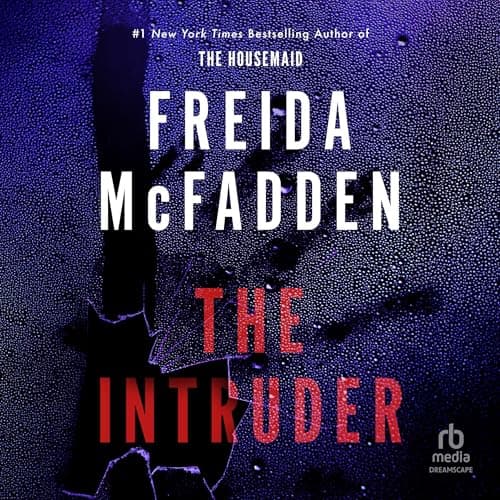

The Intruder is the most effective bottle-episode thriller I've listened to this year. One cabin. One storm. Two women who can't leave. A knife that never gets put down.
Here's the setup: Casey is alone in a remote cabin when a hurricane rolls in. Then a girl shows up outside her kitchen window — young, bloody, gripping a knife, and refusing to explain any of it. Casey lets her in, because what else are you going to do? And from that moment, McFadden locks you inside with them and starts tightening screws you didn't even know were there.
I listened to this on a Saturday afternoon while reorganizing my garage. Bad idea. By the halfway point I'd stopped pretending to sort tools and was just standing there holding a socket wrench, staring at the wall, fully absorbed. This is not a background listen. The story demands your attention because the tension lives in the silences between what Casey and Ella say to each other — what's implied, what's withheld, what's deliberately misdirecting you.
The three-narrator format is what pushes this from good thriller to great audiobook. Patricia Santomasso voices Casey with a warmth that gradually turns brittle as her instincts start screaming. You can hear the exact point where her compassion and her fear start fighting each other, and Santomasso makes that internal war feel physical. Tina Wolstencroft handles Ella — the blood-covered girl — with real discipline. She sounds young without sounding cartoonish, vulnerable without tipping into victim mode, and threatening without losing your sympathy. That's an incredibly hard balance, and she holds it for the entire book. Joe Hempel comes in as Lee, Casey's neighbor, and his sections are fewer but they land hard, especially in the final act when the story's threads pull tight.
The character switches never confused me. Each narrator owns their perspective completely, which matters because unreliable perspectives are the engine driving this plot. You're constantly recalibrating who you trust, and the vocal performances add a layer of ambiguity that print can't replicate. When Ella says something that might be a lie, Wolstencroft delivers it with just enough sincerity that you can't be sure. That uncertainty is where the dread lives.
McFadden's pacing here is surgical. She understands that a locked-room thriller works best when the pressure builds slowly. The hurricane traps everyone physically, but the real confinement is psychological — Casey can't verify anything Ella tells her, can't call for help, can't leave. The middle section, where Casey discovers something deeply wrong in the dead of night, had me rewinding twice. Not because I missed audio — because I needed to confirm what I'd just heard was actually what happened. That's a rare feeling in a genre where I usually see the moves coming three chapters early.
The twist ending is genuinely earned. McFadden plays fair with her clues, seeding them in dialogue and small behavioral choices that the narrators deliver with exactly the right amount of ambiguity. When the reveal lands, it doesn't feel like a cheat — it reframes everything you've heard and adds real emotional weight to scenes that were already tense. I went back and listened to two early chapters again afterward, and sure enough, the signals were there. That's satisfying in a way that most thriller twists aren't.
At eight hours and nineteen minutes, there's nothing wasted. No subplot detours, no backstory dumps, no filler. Every scene earns its spot. Never Lie uses a similar isolated-setting-with-secrets structure, but The Intruder runs tighter and gives its narrators more distinct territory to work with, even if Never Lie's central mystery has a bit more psychological complexity.
My one reservation: the ending leaves a couple of threads loose. Some listeners have flagged unanswered questions, and while I think the ambiguity is partly intentional, there were moments where one more minute of resolution would have been welcome. It's a small crack in an otherwise airtight structure.
You should listen to this if you want a locked-room domestic thriller built on unreliable perspectives, can commit your full attention for one sitting, and enjoy the kind of twist that makes you immediately revisit earlier chapters. Skip it if you need procedural investigation beats, want lots of physical action, or require every plot thread tied off neatly. This is a psychological pressure cooker, not an action thriller, and it rewards focused listening over multitasking.