
I was grading a stack of sophomore essays on symbolism in Gatsby - the same five observations about the green light I've read for twenty years - when I decided I needed a palate cleanser. Something short. Something that would remind me why I fell in love with American literature in the first place. Twenty-five minutes later, I sat there with a red pen frozen over Jayden's paper, genuinely unsettled.
This is why we still read the classics.
The Trick Bierce Plays on Your Perception
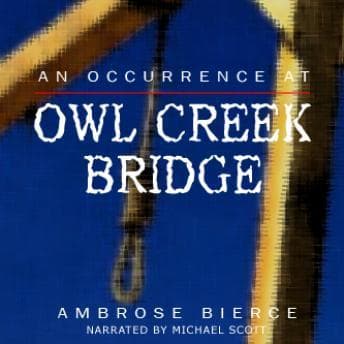
Ambrose Bierce was a Civil War veteran who saw combat at Shiloh, and you feel that authenticity in every deliberate sentence. If you want to see how differently the same mind processes that combat experience in a quieter register, Bierce's Devil's Dictionary is a fascinating companion piece - same author, completely different armor. The story opens with Peyton Farquhar standing on Owl Creek Bridge, a noose around his neck, Union soldiers preparing his execution. What follows is one of the most famous narrative deceptions in American literature - and honestly, it works even better in audio than on the page.
Here's what Bierce understood that my students struggle to grasp: the author chose those words. Every single one. The shift from cold military precision in the opening to the almost dreamlike quality of the middle section isn't accidental. It's psychological architecture. Michael Scott's narration captures this transition - the clipped, formal description of the execution preparations gives way to something more fluid, more desperate, more alive. You're inside Farquhar's consciousness without quite realizing you've been pulled there.
The irregular time sequence? That's putting it mildly. Bierce was doing things with narrative structure in 1890 that film students now study as foundational technique. The Twilight Zone adapted this story. So did French directors. There's a reason it endures.
Every Sentence Carries Weight
This is essentially a short story, and the brevity works in its favor. No padding, no meandering subplots, no filler. You get the setup, the psychological journey, and that ending - the one that's been shocking readers for over a century.
Michael Scott delivers a competent reading. I focused on the performance itself, and noticed nothing that pulled me out of the experience. He brought that same unobtrusive steadiness to War of the Worlds, which I reviewed a few months back - a narrator who knows when to get out of the text's way is rarer than you'd think. No distracting accent choices, no rushed passages, no moments where I thought "that's not how Bierce intended this to land." For a story this dependent on precise pacing and tonal control, that's actually high praise. The narration serves the text rather than competing with it.
The pacing feels right. The execution scene has appropriate gravity. The escape sequence - without spoiling anything - builds with exactly the kind of sensory intensity Bierce wrote into it. The sounds of the creek, the description of physical sensation, the almost hallucinatory quality of perception under extreme stress. Scott lets these moments breathe.
The Iceberg Beneath Farquhar's Creek
Hemingway talked about the iceberg theory - the dignity of movement of an iceberg is due to only one-eighth of it being above water. Bierce was doing something similar decades earlier. What's happening beneath the surface of this narrative is far more significant than what appears on it. And that's the genius of experiencing it as audio: you can't flip ahead. You can't peek at the ending. You're trapped in Farquhar's timeline, moving forward at exactly the pace Bierce intended.
My students would hate this. I love it.
The twist ending has been copied so many times that some modern readers might anticipate it - though I'd argue knowing doesn't diminish the impact. This isn't a gotcha story. It's a meditation on consciousness, time, and the desperate human will to survive. The ending isn't cheap; it's earned through every carefully constructed sentence that precedes it.
Who Should Queue This Up (And Who Should Skip)
If you love Poe or early Hawthorne, this is essential listening. If you're teaching Civil War fiction or early psychological realism, this belongs in your rotation. If you've got a twenty-five minute walk and want something that'll stick with you far longer than its runtime suggests - this is it.
Skip it if you need action-heavy plots or if ambiguity frustrates you. And maybe don't listen right before bed. I made that mistake once with another Bierce story and spent an hour staring at the ceiling.
Worth Pausing the Faculty Meeting For
At under half an hour, this is essentially the literary equivalent of a perfect short film. It does one thing - explores the space between life and death, between reality and desperate hope - and does it with precision that still influences writers today. The narration is solid, the source material is canonical for good reason, and the experience is worth the minimal time investment.
Principal Martinez, if you're reading this: I finished listening during your facilities update. The Bierce was more compelling. Nothing personal.