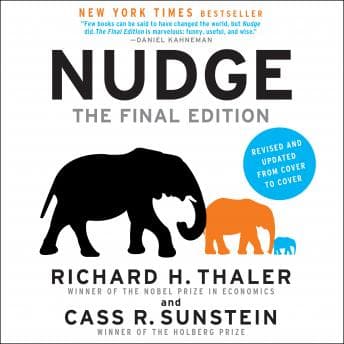

Thaler won a Nobel Prize for this stuff. Let that sink in for a second.
I finished Nudge at 2.0x speed during a red-eye to Denver, sandwiched between a snoring sales guy and a woman who kept elbowing me for armrest dominance. Perfect environment, actually - I needed something intellectually stimulating enough to keep me from committing a federal crime at 35,000 feet.
What My Parents Already Knew (Now With Academic Citations)
Here's the thing about behavioral economics books: half of them are just documenting what every small business owner figured out through trial and error. My parents ran their dry cleaning shop with nudges before the word existed. The candy display at eye level for kids? Nudge. The "ready by 5pm" default instead of asking customers when they wanted pickup? Nudge. The loyalty punch card that was always "almost full"? Pure choice architecture.
But Thaler and Sunstein do something most business books fail at - they give you the framework to understand why these things work. The concept of "sludge" alone is worth the listen. Sludge is all the friction companies deliberately add to stop you from doing things they don't want you to do - canceling subscriptions, claiming rebates, getting refunds. Once you see it, you can't unsee it. I've used this framework with three different startup clients this quarter. It works.
The practical application piece is what separates this from theory-heavy business books—Three Signs of a Miserable Job does something similar by grounding management concepts in actual workplace scenarios.
The COVID-19 additions feel timely without being preachy. The organ donation chapter still hits hard - the difference between opt-in and opt-out countries in donation rates is staggering. This is policy that saves lives, not theoretical hand-wraving.
Sean Pratt: Credible but Caffeinated Squirrel Kryptonite
Sean Pratt sounds like your most respected economics professor - the one who genuinely knows his stuff but could put a caffeinated squirrel to sleep. His delivery is "professorial in the best sense" according to some listeners, and sure, I get that. There's a certain credibility to his measured, academic tone.
But here's my honest take: at 1.0x, this audiobook is a slog. Pratt's pacing is so deliberate, so methodical, that even at 2.0x I found my attention drifting during the mortgage chapter. The monotone delivery flattens what should be fascinating material. When you're explaining why people make terrible 401(k) decisions, some vocal variety would help.
I've listened to hundreds of business audiobooks. This one required more active focus than most. Not because the content is dense - it's actually written quite accessibly - but because the narration doesn't do any of the heavy lifting. You have to meet it more than halfway.
Skip to Chapter 5? Actually, No.
Unlike most business books where I'd tell you to skip the first third, Nudge builds systematically. The early chapters on choice architecture and libertarian paternalism (their term, not mine) set up everything that follows. The payoff comes in the application chapters - retirement savings, healthcare decisions, climate policy.
At 11.5 hours, it's a commitment. But here's what separates this from the usual business book bloat: most of those hours contain actual ideas. Novel concept, I know. Thaler and Sunstein respect your intelligence without being inaccessible. They use examples that stick - the cafeteria layout study, the fly in the urinal, the "save more tomorrow" program.
Jenny would say I'm being generous because I'm biased toward anything with real research behind it. Jenny is right. But she'd also agree that a Nobel laureate has earned the benefit of the doubt.
Who Gets the ROI (And Who Doesn't)
Essential listening if you're in product design, policy, management, or honestly just trying to understand why you keep making bad decisions about money. The framework applies everywhere - I've used it to restructure client onboarding flows, employee benefit selections, even my own morning routine.
Skip this if you need entertainment value from your audiobooks, you're looking for quick tactical tips without theory, or you genuinely cannot handle slow narration even at increased speeds. Some listeners reported the narrator "ruined everything" - I wouldn't go that far, but I understand the frustration.
Worth the Credit, Not the Default Speed
The ideas here are genuinely valuable. The "Final Edition" updates feel substantial, not like a cash-grab repackaging. Thaler and Sunstein have spent a decade watching their concepts get implemented (and sometimes butchered) by governments and companies worldwide. That experience shows.
But - and this is a significant but - you're paying a tax in attention and engagement because of the narration. Bump it to 1.5x minimum. 2.0x if you're comfortable there. The content deserves better delivery than it got, but the content is strong enough to survive it.
My 2.0x speed couldn't fully save this one, but it made it worthwhile. That's more than I can say for most business audiobooks sitting unfinished in my library.