
"Your circumstances are not the reason you can't succeed. They're the reality in which you must succeed."
That line hit me somewhere around the 90-minute mark while I was meal-prepping at midnight - Jenny's out of town, which means I'm batch-cooking Korean stews at unreasonable hours and catching up on my audiobook queue. And honestly, Cy Wakeman's whole thesis stopped me mid-julienne because it sounds exactly like something my mother would've said. In Korean. With less patience.
What My Parents Knew Before HR Had a Budget
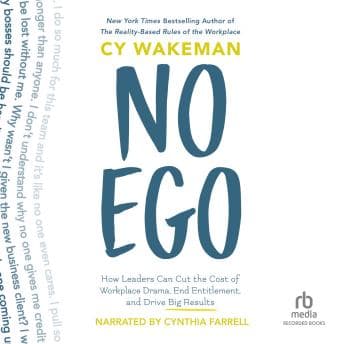
Bottom line: This is a 4-hour-46-minute argument that most of what corporate America calls "engagement" is actually just expensive coddling. Wakeman's central claim - that ego, not disengagement, is the real productivity killer - is the kind of take that gets you uninvited from HR conferences. And she's largely right.
Here's the framework: employees operate from either ego (stories, drama, resistance to change) or from a place of accountability. Most engagement surveys, according to Wakeman, just measure how happy people are - not how productive. She calls the gap between what's actually happening and the emotional energy wasted on stories about what's happening "emotional waste." I've seen this at three different companies. The team that spends 45 minutes in the hallway after a reorg announcement processing their feelings about it? That's emotional waste. The Slack channels devoted to speculation about the new VP's "real agenda"? Emotional waste.
What I genuinely appreciated is that Wakeman doesn't just diagnose - she provides specific tools. Her "ego bypass" questions are actually useful. Things like asking employees "What do you know for sure?" to separate facts from stories. Or her accountability formula that factors in someone's emotional expensiveness to the organization. I've already adapted a version of her "Business Readiness" assessment for a Series B client that's drowning in founder-coddled entitlement culture. It worked. Within two weeks.
This is what my parents did instinctively. Now it has a TED talk. My dad didn't do engagement surveys at the dry cleaners. You showed up, you did your job well, you found meaning in doing it well. If you had drama, you kept it outside. Was that perfect management? No. But there's something in Wakeman's framework that captures the kernel of truth in that approach while making it actually humane.
Where the Thesis Gets Too Clean
Here's where I push back - and Jenny would say I'm being harsh. Jenny is right. But I'm saying it anyway.
Wakeman sometimes treats "ego" as this monolithic villain without acknowledging that some workplace frustration is legitimate signal, not noise. When your company's going through its fourth reorg in eighteen months and leadership communication has been garbage, the employee who's upset isn't necessarily operating from ego. They might just be correctly reading a dysfunctional system. Wakeman's framework can too easily become a tool for bad leaders to dismiss valid criticism as "drama."
She also leans heavily on her own consulting data without much external validation. The stats she cites - like the claim that the average employee spends 2.5 hours per day in drama - feel directionally correct but the sourcing is thin. As a consultant myself, I know how easy it is to build a framework around your own client engagements and call it universal truth.
That said, the book is mercifully short. At under 5 hours, Wakeman practices what she preaches about respecting people's time. Finally, a business book that respects your time. I didn't have to skip a single chapter, which is genuinely rare in this genre. Less Doing, More Living promised the same efficiency-first ethos and mostly delivered, though it lacked Wakeman's sharpness on the human cost of wasted energy. There's no 40-page origin story about how she discovered her method while hiking in Patagonia. She gets in, makes her case, gives you tools, gets out.
Cynthia Farrell Does the Job
Cynthia Farrell's narration is clean and professional - she's an Earphones Award winner and it shows. No weird pacing issues, no pronunciation stumbles. She reads Wakeman's slightly confrontational tone without making it sound preachy, which is harder than it seems. It's not the kind of performance that makes you forget you're listening to a business book, but it's exactly the kind that lets the content breathe without getting in the way. At 2.0x, she still sounded crisp, which is my real quality test.
Who Gets the Most ROI Here
If you're a mid-level manager drowning in team drama - the passive-aggressive emails, the "I'm just not sure about the direction" feedback loops, the people who need to process every change through seventeen emotional stages before doing their job - this book is for you. Skip to the sections on Editing Your Story and the Business Readiness assessment. Those alone are worth the credit.
If you're a founder who's been told the answer to retention is more kombucha and ping pong tables, listen to this before your next all-hands.
If you're an employee looking for validation that your workplace is toxic? This book will annoy you. Possibly productively.
The Consulting Engagement Summary
I'm recommending this to two clients on Monday. The core framework is genuinely useful - not groundbreaking if you've read Brené Brown's accountability work or studied Stoic philosophy (Wakeman is basically Marcus Aurelius in a blazer), but it's packaged practically for the people who need it most: overwhelmed managers who've been told that leadership means making everyone comfortable. It doesn't. Wakeman gets that. My parents got that. The key takeaway is worth the listen. The other 7 hours? There aren't any. Which is the highest compliment I can give a business book.