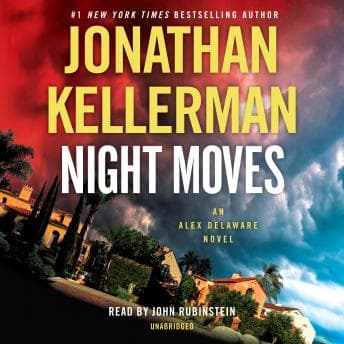

Look, I need to vent about something. Psychological thrillers that promise a "baffling" mystery and then actually deliver one? They're testing me. I finished Night Moves at 1 AM, lights blazing in my apartment because apparently I can't handle a faceless corpse appearing in some rich family's living room without needing to see every corner of my own space. Shirley was unimpressed by my paranoia. She's seen me scared before.
But here's my complaint: Kellerman knows exactly what he's doing, and it's almost annoying how well-oiled this machine is. Thirty-three books into the Alex Delaware series, and the man hasn't lost a step. That's not fair to the rest of us who struggle to maintain consistency across a podcast season.
The Corpse Without a Face (Or Hands, Or Identity)
This setup is horror-adjacent in the best way. A mutilated body - face and hands removed, no ID, no apparent connection to the family whose home it's dumped in. The Corvins are wealthy, guarded, and radiating that particular suburban discomfort that screams "we're hiding something." Their neighbor? A reclusive cartoonist with what Kellerman describes as a "warped sense of humor" - and Rubinstein voices him with this flat, unsettling affect that made my skin crawl.
Kellerman understands that horror isn't about gore - it's about dread. And while this is technically a procedural thriller, the psychological unraveling of this neighborhood operates on that same frequency. Everyone's watching everyone. Everyone's lying. The grass is immaculate and the secrets are rotting underneath.
Rubinstein Gets It
I've said it before on the podcast: audiobook narrators are actors. The ones who understand this create magic. John Rubinstein? He commits. Twenty-plus years voicing Alex Delaware and Milo Sturgis, and he still brings texture to every interaction between them. Alex's measured psychological observations versus Milo's gruff impatience - Rubinstein nails the rhythm of their partnership without ever making it feel performed.
But what impressed me more were the secondary characters. The Corvin family is a study in dysfunction: the father's obnoxious deflection, the mother wound so tight you can hear the tension in her vowels, the teenagers navigating that particular teenage horror of knowing your parents are full of it. Rubinstein gives each of them distinct vocal signatures without veering into caricature. Subtle tone shifts. Nothing showy. Just craft.
The dialogue scenes - and there are many, because this is a character-driven investigation - never drag. That's rare in a 12-hour mystery. Usually by hour 8, I'm reaching for the speed controls. Not here.
Where It Wobbles
I won't pretend this is flawless. The final act rushes. Kellerman spends so much time carefully constructing this web of corrupted love and cold-blooded greed - his words, but accurate - that when the threads finally pull together, it feels slightly hurried. The denouement lands, but I wanted to sit with it longer. Wanted more psychological unpacking of the reveal.
Also, and this is minor, but if you're new to the series, you might find Alex and Milo's dynamic so established that it borders on shorthand. They've been doing this dance for decades. Kellerman assumes you're along for the ride. If you are, it's comfortable. If you're not, there's a slight learning curve to their rhythm.
Who Should Listen (And Who Should Skip)
If you scare easily, this won't terrify you - it's not that kind of thriller. But if you want a procedural that respects the genre, that builds genuine unease through character rather than cheap twists, this is your book. Fans of the Delaware series will be thrilled - this is one of the tightest entries in years. Newcomers can absolutely start here; each book stands alone.
Skip if you need constant action. This is investigative, dialogue-heavy, cerebral. The tension is slow-building. The payoff is psychological, not explosive. Devil's Hand: A Thriller operates on that same wavelength—cerebral dread over cheap thrills.
My Podcast Listeners Are Going to Love This
I'm already planning the episode. There's something to be said about how Kellerman - a clinical psychologist himself - writes Alex Delaware's observations. It's not armchair psychology. It's the real thing, filtered through decades of understanding how people break. How they hide. How they reveal themselves in the smallest tells. That authenticity is what separates this from something like Summons, which leans more into procedural mechanics than psychological depth.
Rubinstein's been translating that for years, and honestly? This pairing is one of the most reliable in audiobook thriller fiction. Not flashy. Not revolutionary. Just consistently, quietly excellent.
I listened in the dark - mistake, maybe, given the faceless corpse imagery - but worth it. Absolutely worth it.