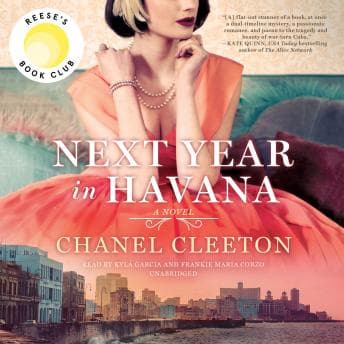

My grandmother never fled a revolution. She fled a bad marriage in 1962 and moved from Mississippi to Chicago, which—according to her—was its own kind of exile. But listening to Next Year in Havana while grading essays about The Great Gatsby, I kept thinking about her. About the stories we inherit. About how the women in our families carry entire worlds in their memories, and sometimes we don't ask the right questions until it's too late.
Chanel Cleeton gets this. She really gets it.
The Weight of Inherited Memory
Here's the thing about dual-timeline novels—they can feel like homework. You're constantly doing the mental math of "wait, which era are we in now?" But Cleeton structures this beautifully. Elisa's 1958 Havana—all sugar baron privilege and revolutionary romance—and Marisol's 2017 journey to scatter her grandmother's ashes don't compete with each other. They converse.
The 1958 sections have that doomed quality I love in historical fiction. You know the revolution is coming. You know this gilded world is about to shatter. And yet Cleeton makes you feel Elisa's naivety, her genuine belief that love can exist outside of politics. (Spoiler: it cannot. It never can. This is what makes historical romance so deliciously tragic.)
Meanwhile, Marisol's contemporary storyline could've felt like filler—the obligatory "modern woman finds herself" plot. But Cleeton gives her genuine stakes. She's not just scattering ashes; she's excavating a family secret that reframes everything she thought she knew. My students would call this "the tea." They're not wrong.
Why the Dual Narration Actually Works
I'll admit—I'm skeptical of multi-narrator audiobooks. Too often they feel like a gimmick, or worse, the voices don't mesh. But Frankie Corzo and Kyla Garcia? They understood the assignment.
Corzo handles Elisa's sections with this warmth that feels like sitting on a porch listening to your grandmother's stories. There's a slight formality to her delivery that fits the era—Elisa is, after all, a society girl—but it never feels stiff. When the revolution closes in and Elisa's world crumbles, you hear the shift. The voice gets tighter. More urgent.
Garcia makes Marisol distinctly modern without turning her into a different species from her grandmother. The cultural authenticity in both performances—the way they handle the Spanish phrases, the rhythms of Cuban-American speech—adds a layer that reading silently just wouldn't capture. I caught myself pausing during faculty meetings (sorry, Principal Martinez) just to replay certain passages.
Some listeners apparently wanted a heavier accent for Elisa. I disagree. The subtlety works. Elisa was educated, privileged, likely spoke multiple languages fluently. The narration reflects her world.
What Hemingway Would Say (Bear With Me)
Hemingway spent time in Cuba. He understood that the island was never just a place—it was always an idea, a memory, a wound. Cleeton writes in that tradition, even if her prose is more accessible than Papa's stripped-down minimalism.
This is a book about exile. About what we lose when we're forced to leave home. About how that loss echoes through generations—Elisa's granddaughter still feels it, still carries it, even though she's never lived in Cuba. The prose deserves to be savored at 1.0x speed. (Yes, I'm that person. My students think I'm ancient. Whatever.)
The romance elements work because they're not just romance—they're political. Elisa's affair with a revolutionary isn't just forbidden love; it's a collision of worlds. Marisol's connection to a man with his own secrets mirrors her grandmother's story in ways that feel earned rather than contrived.
Who This Is For (And Who Should Skip)
If you loved The House of the Spirits or Before We Were Yours, this is your next listen. I got similar vibes from Little Men, though that one trades revolution for quieter domestic drama. Same sweep of family saga, same attention to how history lives in our bodies.
But look—if you're impatient with slower-paced historical fiction, or if you need constant action to stay engaged, maybe sample first. This is a book that breathes. It takes its time. The 11+ hours didn't feel long to me, but I was also walking the lakefront with Denise, and she kept asking why I was getting emotional about "that Cuba book."
(I wasn't crying. It was the wind. Lake Michigan is cold in March.)
The cultural references—Cuban cooking, family dynamics, the specific texture of exile communities in Miami—might feel unfamiliar if you're not plugged into that world. But honestly? That's part of the gift. Let the book teach you something.
Red Pen Down, Phone Call Made
I finished this at 11 PM, grading forgotten, red pen abandoned. Called my mom the next morning to ask about her mother—the one who fled Mississippi. She told me three stories I'd never heard.
That's what good historical fiction does. It sends you back to your own history, your own inherited memories, with new questions.
Chanel Cleeton wrote something that matters. Corzo and Garcia made sure you could hear it.
My students would hate the pacing. I loved every minute.