
What happens when you put a psychology researcher in a dark kitchen at 1 AM, chopping onions for a lamb biryani she absolutely does not need to be making, listening to a story about a woman hiding from a serial killer in a motor home? You get me, white-knuckling a chef's knife, genuinely startled by my own refrigerator humming.
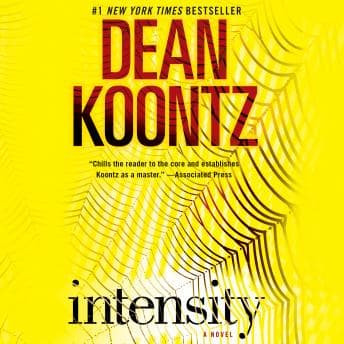
Dean Koontz's Intensity is, on paper, a relatively simple premise: Chyna Shepard survives a home invasion by a self-described "homicidal adventurer" named Edgler Foreman Vess, then makes the psychologically fascinating choice to not escape - to instead follow him, because she's learned he has another victim waiting. That's it. That's the engine. And yet this book kept me up past 3 AM on a Tuesday, biryani abandoned, standing in my kitchen like a fool.
Edgler Vess as a Case Study in Sensation-Seeking Gone Nuclear
The protagonist exhibits classic survivor psychology - hypervigilance, dissociation under stress, the works - but let's talk about the villain, because Vess is where Koontz does something genuinely interesting. He's not your garden-variety psychopath with a tragic backstory. Koontz explicitly refuses to give him one. Vess is a man who has organized his entire existence around feeling things intensely. He kills not out of compulsion or rage but because murder is, to him, the most vivid experience available. He smells flowers, he savors food, he murders people - all on the same spectrum of sensation-seeking.
Psychologically, this tracks better than most thriller villains. The research actually shows that certain personality profiles score high on sensation-seeking scales without the moderating influence of empathy. Vess is that profile cranked to eleven, and Koontz writes him with a philosopher's self-awareness that's deeply unsettling. The passages where Vess internally narrates his own pleasure at being alive - really alive, more alive than the rest of us dull creatures - those got under my skin. My therapist would have thoughts about this character. Many thoughts.
Compare this to something like Stephen King's work, where the evil often has a supernatural or trauma-based origin. Koontz is doing something colder here. Vess isn't broken. He's just... wired wrong. And he's articulate about it. That's the horror. The psychological cold-bloodedness reminded me of what I wrote about in Man Who Knew Too Much - that particular breed of thriller where the threat isn't monstrous so much as simply, chillingly purposeful.
Chyna's Arc - Or, Why Motivation Matters More Than Action
What makes Chyna compelling is not her bravery but her reason for being brave. Koontz spends considerable time in her backstory - a childhood of neglect and abuse by a parade of her mother's terrible boyfriends - and this is where the book gets psychologically rich and also, I'll be honest, occasionally long-winded. The flashbacks to Chyna's past are the book's way of explaining why this woman, who has spent 26 years perfecting the art of self-preservation, suddenly decides that saving a stranger is worth dying for.
I found myself asking: why does Chyna really stay? Is it genuine altruism, or is it that she's finally found a situation where her survival instincts - the ones that made her invisible and small her whole life - can be redirected toward something that means something? Koontz seems to understand this distinction. Chyna isn't a hero because she's fearless. She's a hero because she's been afraid her entire life and she's finally, furiously sick of it.
That said - and this is where some listeners will lose patience - the middle sections drag. By hour seven or so, I was getting restless with the amount of internal monologue and setting description. Koontz describes rooms, roads, weather patterns, the texture of surfaces, with the same intensity Vess brings to, well, everything. It's thematically consistent but narratively slow. Some chapters feel like they exist to maintain atmosphere rather than advance the story.
Frankie Corzo's Narration - The Elephant in the Motor Home
Here's the thing about Corzo's performance: it's competent. Steady. Clear. And for a book called Intensity, that's a problem. The narration has a flatness to it - not bad, exactly, but restrained in a way that doesn't match the material's energy. When Vess should sound seductive and terrifying, Corzo gives you... measured. When Chyna is in full panic, the voice stays controlled. I kept wanting the performance to break open, to match the rawness Koontz puts on the page, and it never quite did.
It's not a dealbreaker. The writing is strong enough that even a neutral delivery carries the tension. But I've heard thrillers where the narrator made me pull my car over because I couldn't drive and listen at the same time. This isn't that.
Who Gets Consumed by This - And Who Walks Away
If you're a character-psychology person (hi, that's me), the Vess-Chyna dynamic is worth the thirteen hours. If you need relentless pacing, you'll hit a wall around the middle act. If flat narration is an automatic dealbreaker, maybe grab the print version instead.
But if you want a thriller that actually earns its villain's philosophy, that understands the difference between surviving and living, and that treats its protagonist's trauma as something more than backstory decoration? This one's worth your time.
The Session Notes
Koontz wrote a book about intensity that is, paradoxically, both intensely psychological and occasionally too leisurely for its own good. The character work is sharp. The narration is adequate. The biryani I abandoned was unsalvageable by morning. Some books demand your full attention and punish you for giving it. Intensity rewards it - mostly.