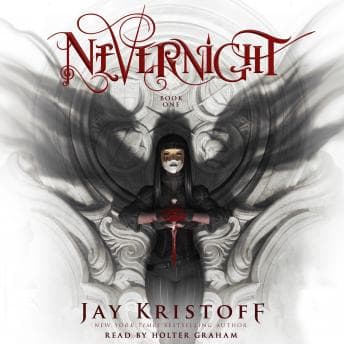

Look, I'll be honest—I went into Nevernight expecting a pretty straightforward assassin school fantasy. What I got was 20 hours of Jay Kristoff basically showing off his prose skills while making me miss my Caltrain stop. Twice.
The setup is familiar enough: Mia Corvere's dad gets executed for treason, she escapes, finds a school of assassins, trains to murder everyone responsible. It's basically John Wick meets Hogwarts but with three suns and way more footnotes. Yes, footnotes. In an audiobook. We'll get to that.
The Narrator Breaking the Fourth Wall (And Making It Work)
Here's where things get interesting. Holter Graham doesn't just narrate this book—he performs it with this sassy, almost conspiratorial energy that took me a few hours to adjust to. The story has a narrator character who literally interrupts the action to give you worldbuilding asides, historical context, snarky commentary. It's like having someone whisper "oh, you think THAT'S bad? Let me tell you about the time..." in your ear.
Some people hate this. I get it. If you want a clean, linear story, this will drive you absolutely insane. But once I stopped fighting it—somewhere around hour four, stuck between Millbrae and San Mateo—it clicked. Graham leans into the humor perfectly. When the narrator gets sassy, he gets SASSY. The fourth-wall breaks that could've been grating become genuinely funny.
The catch? Graham's a male narrator voicing a teenage girl protagonist. And yeah, it's... noticeable. He's not trying to do a high-pitched female voice (thank god), but there's definitely a disconnect when Mia's having emotional moments. It's not a dealbreaker for me, but I know some people bounce hard off this. Fair warning.
Where the Darkness Actually Lands
This book is dark. Like, content-warning-for-everything dark. Violence, sexual content, trauma—Kristoff doesn't pull punches. But here's the thing: it earns most of it. Mia isn't just edgy for the sake of being edgy. She's a traumatized kid learning to weaponize her pain, and the narrative voice—that snarky, knowing narrator—provides just enough distance to keep it from becoming misery porn.
The worldbuilding is dense. Three suns, a dying god whose bones form the city, shadow magic, a whole pantheon I'm still not 100% sure I understand. The Warded Man has that same ambitious worldbuilding energy, though its magic system felt more grounded. Kristoff throws a LOT at you in the first few hours. I actually had to dial back from my usual 1.75x to 1.5x just to keep up with the mythology dumps. (For a fantasy audiobook to make me slow down? That's saying something.)
Graham's pacing helps here. He knows when to let the prose breathe and when to punch through action sequences. The assassin trials in the Red Church are genuinely tense—I found myself white-knuckling my coffee cup during a few of them.
The Character Voice Problem (It's Real)
Okay, I have to address this because it's a legitimate criticism: a lot of the side characters sound... similar. Graham does distinct voices for the major players, but when you've got a school full of assassin acolytes, they start blending together. I lost track of who was speaking in a few group scenes. Not ideal.
But the main cast? Solid. Mia's sardonic inner monologue comes through clearly. Her shadow-companion Mister Kindly (yes, really) has this dry, flat delivery that's perfect. And the villains—when they show up—are appropriately menacing without going full cartoon.
The ROI Calculation
Twenty hours is a commitment. This isn't a breezy commute listen—it demands attention. The prose is ornate, the worldbuilding is layered, the narrative structure is unconventional. If you're half-asleep at 6AM? You're gonna miss stuff.
But if you've got the bandwidth for it, the payoff is real. By the end, I was completely invested in Mia's revenge arc. The final act delivers. And knowing there are two more books in the series? Already downloaded.
Perfect for: Long flights, weekend binges, anyone who liked Name of the Wind but wanted more stabbing. Skip if: You need your 6AM commute listen, linear storytelling is non-negotiable, or stylistic flourishes make you twitchy.
The science (magic?) doesn't quite hold up to scrutiny—I have questions about how darkin powers work that the book handwaves—but honestly, I stopped caring. Sometimes you just want to watch a teenage girl learn 47 ways to kill someone while snarking about it. This delivers. Paris Rose scratched a similar itch for me, though with less stabbing and more political maneuvering.