
What makes a romance novel feel like a genuine love story rather than just two attractive people bumping into each other repeatedly until the plot demands they kiss?
I was grading a stack of sophomore essays on Romeo and Juliet—the ones where every student insists Shakespeare invented the fake death trope—when I put this on. Denise had already gone to bed, and I needed something to keep me from writing "This is not a thesis statement" in red ink forty-seven more times. By hour two, the essays were forgotten. By hour four, I was genuinely invested in whether a deaf Armstrong woman and a gruff Montgomery warrior could bridge a clan rivalry that had lasted generations.
When Silence Becomes the Story
Here's what Maya Banks does that elevates this beyond standard Highland romance fare: Eveline's deafness isn't a gimmick or a plot device to be "cured" by love. It's the lens through which we experience everything. She reads lips. She watches. She notices what hearing characters miss—the way someone's mouth tightens before they lie, the disconnect between spoken words and body language. Banks uses this perspective to create genuine tension in scenes that would otherwise be straightforward.
The arranged marriage setup is familiar territory, sure. Rival clans, political maneuvering, a bride traded for peace. We've read this before. But Eveline's secret—that she's not "touched" or simple, but intelligent and observant and choosing to let the world underestimate her—gives the familiar structure new weight. When Graeme begins to suspect his new wife is not what she appears, it's not played as a betrayal reveal. It's a slow recognition between two people learning to actually see each other.
This reminds me of what Hemingway said about writing—the dignity of movement of an iceberg is due to only one-eighth of it being above water. Banks keeps Eveline's inner life mostly submerged, letting us piece together her experience through small details rather than internal monologue dumps.
Kirsten Potter Earns That Audie Nomination
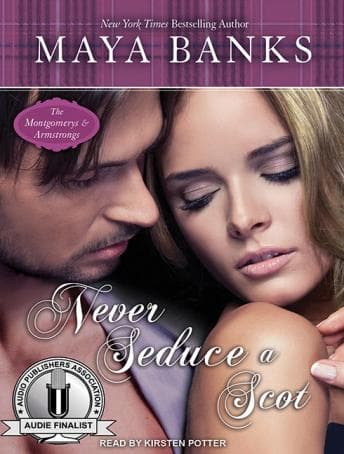
Potter's performance is the reason this works as an audiobook rather than just a competent reading of a romance novel. Her Graeme has this deep, rumbling Scottish burr that you can genuinely believe Eveline might hear—it vibrates in your chest even through earbuds. The contrast with her lighter, more careful voice for Eveline creates an audio texture that reinforces the power dynamic constantly shifting between them.
I'll be honest—there are moments where the Scottish accent wobbles slightly. A word here or there that sounds more "American actor doing Scotland" than authentic. But these are rare enough that I noticed them precisely because the rest is so consistent. Potter handles the large cast of clan members with enough differentiation that I never lost track of who was speaking, which is no small feat in a book with this many Montgomerys and Armstrongs running around.
The emotional scenes hit harder than I expected. There's a moment—I won't spoil it—where Eveline's secret becomes known to someone other than Graeme, and Potter's delivery made me stop grading entirely. Just sat there with my red pen hovering over some poor kid's essay about star-crossed lovers while a fictional medieval Scotswoman made me feel things.
The Bodice Ripper Question
Some readers wanted more heat. More of that aggressive Highland passion that defines the subgenre. And look, if you're coming to this expecting wall-to-wall spice, you might feel the slow burn is too slow. The intimacy builds gradually—Banks is more interested in the emotional connection than the physical one, at least until that foundation is established.
My students would hate this. They want instant gratification, the literary equivalent of a TikTok. But the pacing deserves to be savored here. The tension between Eveline and Graeme works precisely because Banks makes you wait for it. When the physical relationship finally develops, it feels earned rather than obligatory.
That said, this is still firmly a romance with adult content. The violence and abuse elements mentioned in content warnings relate to clan conflicts and some darker backstory elements—nothing gratuitous, but present enough to note.
Who Should Queue This Up (And Who Should Skip It)
If you loved Diana Gabaldon's Outlander but wanted something more focused on the romance and less on the time travel mechanics, this is its spiritual successor in audio form. Romance readers who appreciate character development over trope delivery will find plenty to love. Historical fiction fans who don't mind their history romanticized (we're not aiming for accuracy here, folks) will enjoy the medieval Scottish setting.
Skip this if you need fast pacing or high action. Skip it if Scottish accents in audiobooks pull you out of the story. And definitely skip it if you're looking for a quick, light listen—at ten hours, this asks for your attention.
Worth Pausing the Faculty Meeting For
I finished this during Principal Martinez's quarterly budget presentation. (Sorry, Principal Martinez. The district's allocation formula is very important. I'm sure.) It's the kind of audiobook that makes you resent interruptions—not because of cliffhangers or constant action, but because you genuinely want to spend more time with these characters.
Potter's Audie nomination was deserved. Banks writes with more intelligence than the genre sometimes gets credit for. Sarah's Key has that same quality—a protagonist who refuses to let the world define her limitations. And Eveline Armstrong is the kind of heroine who stays with you—not because she's perfect, but because she's been underestimated her whole life and chooses to use that rather than resent it.
That's worth a credit. That's worth your commute, your dishwashing, your late-night grading sessions. Sometimes the people who see most clearly are the ones the world assumes see nothing at all.