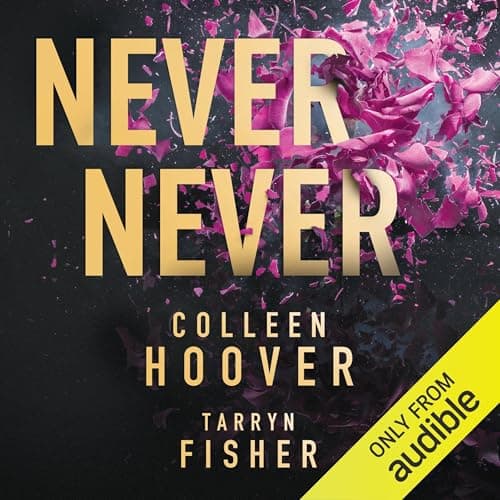

I started this one in the truck at dusk, parked outside a half-framed house after the crew had gone home, sawdust still on my boots and my daughter texting me three grocery items I was absolutely going to forget. That ended up being the perfect mood for Never Never, because this book lives in that ugly little panic of losing what should be basic. Your history. Your person. Your own judgment.
And right away, Colleen Hoover and Tarryn Fisher give you a hook that works: Charlie Wynwood and Silas Nash wake up with their memories gone, even though they've been best friends since they were little and in love since they were 14. Not strangers in the normal romance-novel way. Actual strangers wearing the wreckage of a relationship they can't remember building. That part? Solid. Construction foreman approved. It gives the story a built-in question that kept me listening at 1.4x and still gripping the wheel.
When the floor plan is mystery and romance at the same time
What kept me in this story wasn't just the amnesia gimmick. It was the way Charlie and Silas have to investigate themselves. They're not just asking, "What happened to us?" They're asking, "Why were we together in the first place?" That's a stronger question, and a meaner one.
Because the more they uncover about their first kiss, old fights, and the habits of their relationship, the less secure the fairy-tale setup feels. I liked that. Real couples aren't held together by chemistry alone. This is how real families survive — memory, trust, routine, forgiveness. So when a book strips all that away, I pay attention. I ran into that same gut-punch idea about identity and authenticity in Reclaiming Art in the Age of Artifice — different subject entirely, but the same uncomfortable question underneath: what's left of you when the things that defined you get stripped away?
There's a nasty little tension running through Never Never where every recovered clue could either pull them closer or make them realize they were bad for each other. That uncertainty does real work. It keeps the pages — well, hours — moving. This isn't literary slow-burn where you sit around admiring the drywall texture. It's more like walking through a house and realizing somebody moved load-bearing walls while you were asleep.
But. And this matters.
The ending is where listeners are going to split hard. I get why some people called the Part 3 conclusion mind-blowing, and I also get why others felt burned by it. I landed somewhere in the middle. I didn't hate where it goes, but I did feel the explanation asks for more trust than the setup earns. Measure twice, cut once — for facts too. When you build a mystery this dependent on a final reveal, that reveal has to carry the full load. Here, it carries most of it. Not all.
Two narrators, one strong lane and one bumpy shoulder
The dual narration was the right call. Kevin R. Free handles Silas, Elizabeth Evans handles Charlie, and the separation helps a lot because this story depends on hearing two people process the same disaster from different emotional angles.
Elizabeth Evans was my steadier anchor. Her Charlie has that mix of confusion, fear, and stubbornness that keeps the character from turning wispy. You can hear Charlie trying to piece herself together while also refusing to be handled. That worked for me.
Kevin R. Free as Silas is more of a mixed bag. As Silas himself, he's good — warm, unsettled, believable as a guy trying to stay useful while his whole reality is slipping. Where the performance gets shaky is in some of the voices he uses for other characters. Not a train wreck. No major production problems, no weird editing, no sound issues. Just a few side-character choices that pulled me out for a second and made me think, alright, maybe don't decorate that room so aggressively. Some listeners flat-out disliked his character voices, and I can't say they imagined that.
Still, the audiobook format helps this story more than it hurts it. Since Charlie and Silas are both scrambling to understand what kind of people they used to be, hearing those reactions out loud gives the confusion a more immediate edge. No music, no gimmicky sound effects, just clean audio and two performances carrying the load.
Who gets the keys (and who should keep driving)
You should pick this up if you like relationship mysteries where the central question is emotional before it's logical. You're here for two people digging through the ruins of their own love story, and you can live with a payoff that's more divisive than airtight.
You should probably pass if you need every twist to click into place like good framing. Or if you mostly listen half-distracted while doing five other things. This one needs focus. Miss one key reveal, one shift in what Charlie or Silas believes, and you'll spend the next hour trying to find the stud through drywall.
For CoHo listeners, I'd put this closer to the twist-chasing energy of Verity and Layla than the more grounded emotional lane of Hopeless or Maybe Someday. But Never Never is its own weird animal because the romance and the mystery are constantly stepping on each other's boots. Sometimes that friction is exactly what makes it fun. Sometimes it makes the structure wobble.
My final take? Good listen. Not a perfect build. The central premise is strong enough to carry you, the dual narration mostly works, and the story keeps asking the kind of uncomfortable questions that make a romance more interesting than plain wish fulfillment. But that last stretch is going to decide whether you feel thrilled or slightly conned.
I'd say borrow it, stream it, or catch it on sale before burning a full credit. If you like messy love, missing memories, and a mystery that dares you to keep trusting it, there's enough here to make the drive home go faster.
And yeah — my daughter would call this one scary, just not for the reasons she thinks.