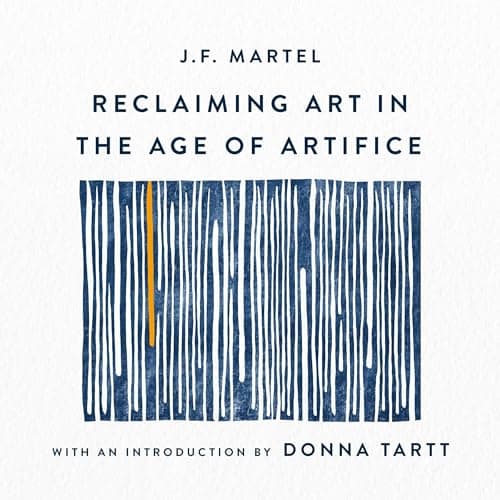

"Art is a rift onto the real." Martel drops this line somewhere around hour two, and I had to stop mid-chop — I was halfway through dicing onions for a chana masala I had no business making at 10 PM on a Wednesday — because that sentence reorganized something in my brain. Not in a mystical way. In the way a good theoretical framework suddenly clicks and you realize you've been circling the same idea in your own work without the vocabulary for it.
Let me back up.
The Difference Between a Mirror and a Window
Martel's central argument is deceptively simple: there is a categorical difference between art and artifice. Art opens rifts — his term — onto something genuinely other, something that disrupts our comfortable consensus reality. Artifice, by contrast, is manipulation dressed up in aesthetic clothing. Advertising. Propaganda. The algorithmic feed that knows exactly which emotion to trigger next. He traces this distinction from Paleolithic cave paintings through Kubrick, through Tarkovsky, through the Surrealists, and the range is genuinely impressive for a book that clocks in under five hours.
What I found myself asking: why does this argument feel so urgent right now? And I think it's because Martel is making a psychological claim, not just an aesthetic one. He's saying that authentic art activates something in the human mind that cannot be replicated by algorithmic optimization — a confrontation with mystery, with the weird (he uses that word deliberately, in its older sense). The research actually shows that encounters with the sublime produce measurably different neurological responses than encounters with the merely pleasant. Martel doesn't cite neuroscience, but his intuitions track with it.
The protagonist here — because yes, I treat philosophical arguments like characters — exhibits classic pattern-recognition anxiety. Martel is someone who can see the machinery of manipulation everywhere and is desperately trying to articulate what exists beyond it. That desperation gives the book its energy. This isn't a detached academic survey. It's a manifesto written by someone who genuinely believes art might be the last uncolonized territory of human consciousness. The question of what it actually takes to protect and sustain creative work in that territory is something Practice: Shipping Creative Work tries to answer from the other side — less philosophical, more tactical, and honestly a much messier argument for it.
When the Author Reads His Own Manifesto
Martel narrates the bulk of the book himself, and — I'll be honest — this is where things get complicated. He reads with the measured cadence of a podcast host, which makes sense given his Weird Studies background. It works for the philosophical passages. His pacing when discussing, say, the difference between Lascaux cave art and modern advertising gives you room to actually think, which this material demands. But there's a flatness in the longer stretches that made me drift during my Thursday morning jog through Cambridge, and I had to rewind twice during a section on Heidegger.
Donna Tartt's introduction is a different animal entirely. Her voice has this specific gravity to it — unhurried, precise, like someone who chooses every word knowing it costs something. The contrast when you shift from Tartt's introduction into Martel's main text is noticeable. Not jarring, exactly, but you feel the register change. Tartt sounds like she's reading from a leather armchair in a room with no overhead lighting. Martel sounds like he's giving a particularly passionate lecture in a well-lit seminar room. Both are fine. They're just different temperatures.
No music, no sound effects, no production tricks. Just two voices and ideas. For a 4-hour-38-minute philosophical meditation, that's the right call.
What Psychologically Tracks (And What Doesn't Quite)
Martel's framework for distinguishing art from artifice is genuinely useful. His argument that artifice operates through what he calls "coercion" — emotional manipulation designed to produce a predetermined response — is something I've written about in my own research on narrative persuasion, though I use different terminology. When he talks about how consumer culture co-opts aesthetic experience to manufacture desire, psychologically, this tracks. We know from decades of persuasion research that emotional arousal bypasses critical evaluation. Martel gets this.
Where I push back: his definition of "authentic art" sometimes slides into mysticism in ways that resist interrogation. Art reveals "the radical mystery at the heart of the world" — okay, but what does that mean operationally? How would we distinguish a genuine rift from a persuasive simulation of one? My therapist would have thoughts about this — she'd probably say I'm trying to operationalize the numinous, and she'd be right, and I'd still want an answer.
But maybe that's the point. Maybe the refusal to provide a clean metric IS the argument. The things that matter most resist measurement. As a researcher, this makes me itchy. As a human who stood in front of a Rothko once and forgot where she was for several minutes, I get it.
Who Should Listen (And Who Should Skip)
If you've listened to Capitalist Realism and wanted someone to articulate what exists BEYOND the critique — what's actually worth preserving — this is your book. If you find yourself uncomfortable with how much of your aesthetic life is curated by algorithms, Martel gives you language for that discomfort.
Skip it if you need concrete prescriptions, specific practices, a five-step plan for "reclaiming" anything — you'll be frustrated. This is diagnosis, not treatment. And at under five hours, some arguments feel compressed when they deserved room to breathe.
The Rift I'm Still Thinking About
I finished this three days ago and I keep returning to Martel's distinction between the sublime and the weird — that authentic art doesn't just elevate us, it estranges us from our assumptions. This is a fascinating case study in someone trying to build a philosophical defense of art that doesn't collapse into either elitism or relativism. He mostly succeeds. The 4.96 rating from listeners doesn't surprise me; this is the kind of book that finds its exact audience and hits them precisely where they need it.
I scraped the last of the chana masala out of the pot at midnight, alone in my kitchen, thinking about cave paintings. Make of that what you will.









