
Post-Shift Confession: I Learned More About Antique Pistols Than I Ever Wanted
Okay, so here's the thing. I picked this one up because I needed something different after back-to-back shifts that included two codes and a patient who decided 4 AM was the perfect time to pull out his own IV. (Spoiler: it never is.) I wanted a classic mystery, something with an actual detective doing actual detecting, not another medical thriller where I'd spend the whole drive home muttering about incorrect intubation procedures.
I Am Pilgrim scratched that same itch for me—competent protagonist, methodical investigation, no medical nonsense to yell at.
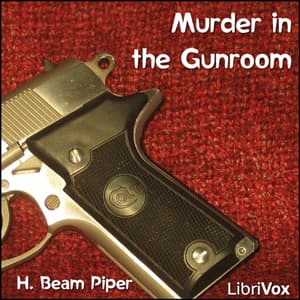
H. Beam Piper's Murder in the Gunroom delivered on the mystery front. But I need to be honest with you—this book and I had a complicated relationship.
The Gun Thing. Oh, The Gun Thing.
Look. I grew up in a household where my lolo kept exactly one shotgun and we didn't talk about it. My knowledge of firearms extends to "that's a gun" and "that's a bigger gun." So when Jeff Rand starts cataloguing Lane Fleming's collection and Piper goes into excruciating detail about the difference between a Paterson .34 and a Texas .40 with a ramming-lever, I felt like I was back in nursing school trying to memorize cranial nerves.
Except cranial nerves are useful in my actual life.
I'm not saying the gun stuff is bad—it's clearly written by someone who genuinely loves and knows antique firearms. Piper was apparently a sci-fi writer mostly, and this was his only mystery, which explains why it reads like someone who really, really wanted to share his hobby with you. I actually went back and listened to Five Sci-Fi Short Stories by H. Beam Piper after this to see if his usual work had the same energy—turns out he's way more restrained when he's writing about space travel than antique firearms. Like when my tita corners you at a party to explain her entire orchid collection. You can tell there's passion there. But also, you're looking for the exit.
That said, if you're into guns? Into collecting? You'll probably eat this up. Carlos's dad would absolutely love this book. He'd be pausing every five minutes to explain what Piper was talking about. For me, I let about 40% of the technical details wash over me like background noise during a quiet night on the unit.
Anthony Wilson's Narration: Steady As She Goes
I couldn't find a ton about Anthony Wilson specifically, but based on this performance? He's solid. Clear voice, good pacing, appropriate tone for a 1950s-style mystery. He's not doing wild character voices or dramatic flourishes—it's more like having a calm, competent colleague read you a really long incident report. And I mean that as a compliment.
This style works for the material. Jeff Rand is a no-nonsense detective who happens to know a lot about guns. He's not a tortured antihero or a quirky eccentric. He's just... competent. Professional. Wilson matches that energy perfectly.
But—and this is important—some people are going to find it monotonous. I get it. Around hour three, during a particularly dense section about percussion revolvers, I did have to bump up to 1.25x speed just to keep myself engaged. Not because Wilson was doing anything wrong, but because the combination of detailed gun descriptions and steady narration started to lull me. And I was driving. On the I-10. At 7 AM after a twelve-hour shift. Not ideal.
(I pulled over for coffee. I'm a nurse. I know my limits.)
The Locked-Room Puzzle Actually Pays Off
Once you get past the gun encyclopedia sections, there's a genuinely good locked-room mystery here. Lane Fleming is found dead in his gunroom, holding a Confederate-made revolver, and it's ruled an accident. His wife isn't buying it. She hires Jeff Rand to appraise and sell the collection, but really she wants answers.
The setup is classic—multiple people wanted that collection, any of them could have motive, and Rand has to figure out not just who but how someone could've killed Fleming in a locked room. I won't spoil it, but the solution is satisfying. It actually makes sense. As someone who's worked a code and knows how often TV gets cause of death wrong, I appreciated that Piper thought through the mechanics.
The pacing is deliberate. This isn't a thriller that's going to have you white-knuckling your steering wheel. It's more of a slow burn, methodical investigation. Which honestly? Perfect for that post-shift decompression. My brain was too fried for anything too intense, and this hit the right note of "engaging enough to stay awake, not so intense I couldn't relax."
Fair Warning
Apparently there are some versions of this audiobook floating around with AI or digital narration, and those sound rough. The version I listened to with Anthony Wilson was fine—clean audio, clearly human. But if you're shopping around and something sounds off in the sample, trust your gut and find a different version.
Also, there are a LOT of characters to keep track of. Family members, potential buyers, servants, other collectors. I definitely lost track of who was who a couple times and had to just roll with it. Taking notes isn't really an option when you're driving, so I accepted some confusion as the price of admission.
The Verdict
This is a niche recommendation and I'm okay with that. Listen if: you love classic mysteries AND have any interest in antique firearms—this is going to be a treat. Or if you're like me and couldn't care less about guns but appreciate a well-constructed whodunit, you can still enjoy it. Just be prepared to zone out during the technical bits. Skip if: detailed hobbyist tangents make you want to throw your phone out the window, or you need faster pacing to stay engaged.
Night shift approved for the post-shift drive home, but maybe bump up the speed during the slower sections. Carlos asked why I kept muttering "I don't care about the barrel length" and I blamed podcast ads. Close enough.
My mom would probably fall asleep during this one. But she still thinks I should've been a doctor, so what does she know.