
Look, I need to talk about the anti-American thing because it genuinely irritated me before I made peace with it.
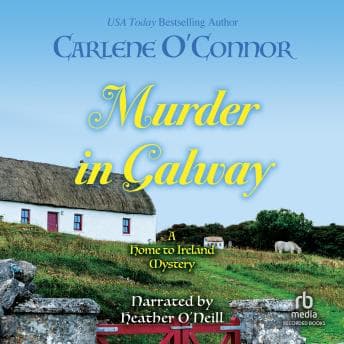
Tara Meehan lands in Galway carrying her dead mother's ashes and a cryptic apology meant for an uncle she's never met, and the locals treat her like she's personally responsible for every loud American tourist who's ever mangled the pronunciation of "Galway." It's relentless. The wariness, the side-eye, the not-so-subtle jabs. And I found myself asking: why does Tara keep taking it? Why doesn't she just leave? But that's exactly the psychological hook O'Connor is working with — Tara can't leave because she's not really there for her uncle or for a murder investigation. She's there because her mother's dying words cracked open the foundational narrative of her own identity. "Tell Johnny I'm sorry. Take me home." Home. A place Tara has never been but that her mother apparently never stopped belonging to.
The protagonist exhibits classic anxious attachment patterns dressed up as amateur sleuthing.
A Dead Man on a Doorstep and a Missing Uncle Nobody Wants to Discuss
The setup is solid cozy mystery architecture: body on the threshold of Uncle Johnny's stone cottage, uncle conveniently vanished, wealthy victim with connections that spread like cracks through Galway's social scene. O'Connor knows the formula. But what kept me engaged — past the point where I should've been asleep, actually, since I was listening in bed after an overly ambitious attempt at paneer tikka masala that left my kitchen looking like a crime scene of its own — was the layered family dysfunction underneath the whodunit.
Tara's mother left Galway and never looked back. Never explained why. Died with an apology on her lips instead of a story. And now Tara has to reconstruct her mother's past from fragments while simultaneously figuring out who killed a man she never knew in a country she's never visited. It's a fascinating case study in how we inherit shame without ever being told what we're ashamed of. The mystery of the murder and the mystery of the family estrangement run parallel, and O'Connor is smart enough to let them feed each other rather than keeping them in separate lanes.
That said — psychologically, some of it doesn't quite track. Tara makes a few investigative leaps that felt more like plot convenience than character logic. There's a moment where she trusts someone she has absolutely no reason to trust, and I wanted to reach through my earbuds and shake her. The research actually shows that people under grief-related stress tend toward hypervigilance, not openness. A woman carrying her mother's ashes into hostile territory would be scanning for threats, not making friends at the pub. But cozy mysteries demand a certain social permeability from their protagonists, so I'll grant O'Connor the genre tax.
Heather O'Neill Made Me Want to Book a Flight
Heather O'Neill's narration is the audiobook's quiet secret weapon. Her Irish lilt doesn't feel performed — it settles over the story like weather, which is exactly right for Galway. The descriptions of the medieval city, the stone walls, the architectural salvage shop full of reclaimed history — they land differently when delivered in an accent that sounds like it belongs there. One listener said her voice made them "yearn to visit Ireland" and honestly, same. By hour three I was googling flights I cannot afford on a researcher's salary.
I will say the character differentiation isn't dramatically varied. You're not getting wildly distinct voices for every Galway local. But O'Neill's emotional delivery carries it — she understands when to let a line sit heavy and when to keep things light. For a nine-and-a-half-hour listen, she maintains a consistent warmth that kept me from getting fatigued even when the pacing dipped in the middle third.
The Gypsy Warning and Other Choices
The fortune-telling woman who warns Tara that "death is all around" — I need to flag this. It's atmospheric, sure. But it's also the kind of narrative shorthand that makes me twitch. Prophetic warnings from mysterious figures are doing a lot of heavy lifting that actual foreshadowing should be doing. O'Connor compensates by making the Galway setting itself feel vaguely ominous — the salvage yard full of fragments from demolished buildings is genuinely evocative — but the mystical stranger bit is a crutch.
What makes this book worth your time is Tara's grief, not the mystery mechanics. The murder gets solved. Fine. But the real payoff is watching Tara piece together why her mother ran from Ireland and whether she's about to repeat the same pattern. Enemy of Mine scratches a similar itch — family secrets doing more psychological damage than any villain in the actual plot.
Who Gets the Prescription and Who Doesn't
If you love Irish settings, cozy mysteries with family secrets, and protagonists who process grief through action rather than reflection — this is your next listen. If unrealistically forgiving protagonists and occasional anti-American snark from side characters will ruin your day, maybe skip it. And if you need your mysteries airtight and psychologically bulletproof — you'll notice the seams, but you might not mind them.
My therapist would have thoughts about Tara's mother. So do I. That's the mark of a character who sticks.