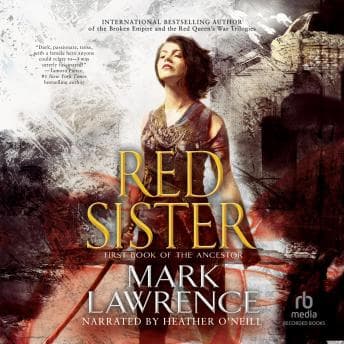

People tell me Mark Lawrence is the king of "grimdark." You know, the kind of fantasy where everyone is miserable, there's mud everywhere, and nobody gets a happy ending. But honestly? Listening to Red Sister while grading a stack of 10th-grade essays on Lord of the Flies (which, let's be real, is just toddlers with sticks compared to this book) felt... surprisingly beautiful.
Maybe it's the exhaustion talking—I've been staring at comma splices for three hours—but this didn't feel like the edgy, depressing slog I was warned about. It felt like a dark fairy tale. A really violent one.
The Nun with the Irish Lilt
Let's talk about Heather O'Neill. I hadn't heard her before this. (I know, I know, I'm usually stuck in the Classics section). But she brings something to the table that most fantasy narrators miss: texture.
Usually, when you pick up a High Fantasy audiobook, you get that crisp, "Received Pronunciation" British accent that sounds like it belongs in the House of Lords. O'Neill brings this warm, soft Irish accent that changes the entire vibe. It makes the story feel ancient. Folklore-ish. When she does the voices for the nuns—sorry, the "sisters"—it doesn't sound like a performance; it sounds like history.
And she sings.
There are songs in the text, and instead of awkwardly reading the lyrics like a poem (which is what 90% of narrators do, and it's always cringe-inducing), she actually sings them. It's haunting. I was walking the lakefront with Denise, and I literally stopped walking to listen to a lullaby about death. Denise asked if I was okay. I wasn't. It was great.
A Syllabus for Assassins
As a teacher, I have a soft spot for "magic school" tropes. But Sweet Mercy Convent isn't exactly Hogwarts. It's more like if Hogwarts was run by the Spartans and everyone had knives. Ember in the Ashes has that same brutal training academy vibe, though the Roman aesthetic hits differently than medieval nuns.
The protagonist, Nona, is a child when we start. O'Neill nails the voice of a kid who has seen too much without making her sound like a cartoon brat. That's a hard line to walk.
The prose itself deserves to be savored. This is why I argue with my students about skimming. Mark Lawrence writes sentences that are meant to be chewed on. "A book is as dangerous as any journey you might take." Come on. That's the kind of line I'd put on my classroom wall if I didn't think the administration would assume I was threatening the student body.
The Speed Limit Debate
Okay, I have to address the pacing.
I am a 1.0x speed purist. I believe the author chose the words and the narrator chose the pauses. But... this is a slow burn. O'Neill reads with a very deliberate, measured pace.
If you're used to thrillers or fast-talking narrators, you might feel the itch to bump this up to 1.25x. (Don't tell the Annotated Life listeners I said that). I stuck with 1.0x because the atmosphere is so thick I didn't want to rush it, but I can see why some people say it drags. It's not a race; it's a mood.
Who's Getting an A, Who's Getting Detention
If you want brutal training academies, quotable prose, and a narrator who makes grimdark feel like folklore—this is your book. Skip it if you need fast pacing or can't handle violence against children (there's a lot of that).
Closing the Gradebook
This is the kind of book that makes me wish I could teach modern fantasy. The themes of friendship, trauma, and destiny are all there, wrapped in a layer of really cool violence. Heather O'Neill turned what could have been a standard action book into something that feels like an oral history from a dying world.
I'm definitely picking up the sequel. Just... maybe not during finals week.