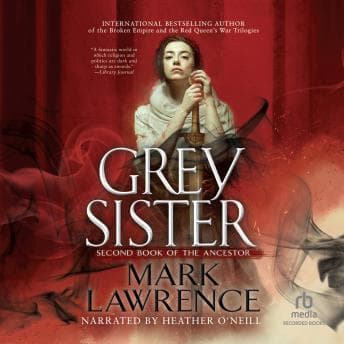

So I was up at 2 AM allegedly debugging a procedural terrain generator for my thesis. Dr. Patel would be proud if he could see my screen. He could not see my screen, because my screen was showing the Audible app at 1.1x speed while I stared at a blank IDE and let Heather O'Neill's Irish lilt wash over me like the Corridor wind sweeping across Abeth. Grey Sister had me by the throat and my thesis had never felt less important.
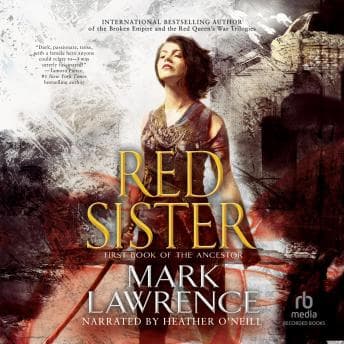
I came off Red Sister absolutely feral for this world. Nuns with blade skills? A dying sun? A magic system built around bloodlines that determine whether you're fast, strong, capable of manipulating threads of reality, or some terrifying combination? Mark Lawrence built something in Book of the Ancestor that hits that exact sweet spot between grimdark and coming-of-age that I didn't know I needed. Grey Sister picks up Nona's story at the convent and - look, if you haven't read Red Sister, go do that first, I'll wait. Actually I won't, because I'm already deep into this review and my thesis isn't going to procrastinate on itself.
The Convent of Sweet Mercy Is Basically Hogwarts If Hogwarts Was Run By Assassin Nuns
What Lawrence does so well here is layer the political intrigue on top of the training-school structure without losing what made Red Sister work. Nona's still figuring out her powers - the hunska speed, the marjal tricks - but now the Inquisition is pressing in on the convent, and Abbess Glass is playing chess at a level that makes you realize just how much was happening beneath the surface of Book 1. The world-building is Sanderson-level in its internal logic but Lawrence delivers it through a much darker, leaner prose style. No hundred-page info dumps here. Everything is earned through character interaction and consequence.
The magic system is chef's kiss. The thread-work that Nona starts learning in Mystic Class - the idea of pulling at the fundamental threads connecting all things - it's genuinely inventive. And Lawrence layers it alongside the physical martial training so that Nona's growth feels like actual progression, not just "she leveled up between chapters." The progression is satisfying in that LitRPG way where you can track a character getting meaningfully stronger, but it never breaks the fantasy immersion. Though I'll admit, the last time I felt progression this earned in an audiobook was in a completely different genre - Girl in the Plane does something similar with its protagonist's internal arc, cramming genuine character development into a fraction of the runtime.
There's a tightening of scope here compared to Red Sister that some people might read as the book being "lesser" - I've seen that complaint floating around. But I think Lawrence is doing something deliberate. The world is literally narrowing (the Corridor of habitable land shrinking as the ice closes in), and Nona's world narrows too as enemies close in from every direction. Lano Tacsis and his vendetta, Joeli Namsis being an absolute snake within the convent walls, the Inquisition treating Abbess Glass like a problem to be solved. It creates this claustrophobic pressure that made me forget I was supposed to be working.
Heather O'Neill's Nona Voice Lives In My Head Now
Okay, the narration. Heather O'Neill does something I wasn't expecting when I first started Red Sister - she gives the whole thing this Irish coloring that shouldn't work for a dying-sun fantasy world but absolutely does. Her voice for Nona specifically is one of those performances where after fifteen hours, the character and the narrator become inseparable in your brain. I literally cannot read a Nona line in print without hearing O'Neill now.
But I gotta be honest - the male voices are a weak spot. Some of the men come out a bit screechy, like she's pushing her register somewhere it doesn't want to go. It's not deal-breaking, and I noticed the editing is tighter than Red Sister (fewer jarring cuts between recording sessions, which was a minor annoyance in Book 1). But if you're someone who needs a Steven Pacey-level range of distinct male voices - Steven Pacey walked so other narrators could run, obviously - you might find yourself occasionally pulled out. For me, O'Neill's strengths so far outweigh this that it barely registers. Her emotional delivery during the moments where Nona's friendships are tested, particularly everything involving Ara and Clera's fallout, hit hard.
Who's Rolling Initiative On This One
If you loved Red Sister, this is a no-brainer. If you like dark fantasy training academies, complex female protagonists who solve problems with both their brains and ultraviolence, and magic systems with real internal rules - get in here. My D&D group would love this as campaign inspiration; the convent's four orders map almost perfectly onto class archetypes.
If you need your fantasy to be sprawling epic travelogue stuff, this isn't that. It's focused, contained, and the stakes are personal before they're political. If you don't like info-dumps, this isn't for you - but actually, Lawrence is pretty restrained about it, so maybe it IS for you? Also, content warning: this gets violent. Like, "Nona has literal devil in her" violent.
Tom's Thesis Can Wait Another Day
I read this instead of writing my thesis. Yes, it's about 16 hours. Yes, it's worth it. Grey Sister is a middle book that doesn't feel like a middle book - it advances Nona's arc meaningfully, raises the political stakes, and ends in a place that had me immediately queuing up Holy Sister at 2:47 AM on a Tuesday. O'Neill's narration isn't perfect, but her Nona is so deeply embedded in this world that switching narrators would feel like a betrayal. Spend the credit.