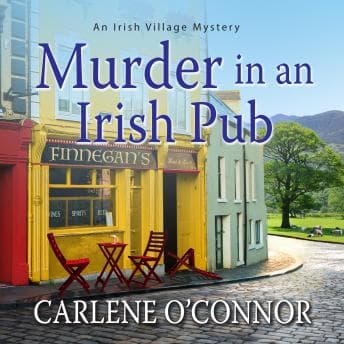

I started this one on a Sunday evening while making dal makhani from scratch - the kind of recipe that requires you to stand at the stove and stir things for longer than any modern person should reasonably agree to. A murder mystery set in an Irish village pub felt like exactly the right company. Cozy premise, low stakes violence, the particular pleasure of watching a small community turn on itself when the body count rises.
Fair warning: I'm going to spend most of this review talking about Caroline Lennon, because she is genuinely doing something interesting here.
What Lennon Does That Most Narrators Don't
Cozy mysteries live or die on their ensemble casts. The village of Kilbane has approximately one million residents, all of whom have opinions, grudges, and reasons to be at a poker tournament. The ensemble-as-pressure-cooker dynamic reminded me of Orchestra of Bandits, where a sprawling cast of morally compromised characters similarly has to be held together by sheer narrative force. The character differentiation challenge is real. Lennon doesn't just do 'Irish accent, slightly different pitch' for each person - she builds actual personalities into the voices. Seamus talks fast in a way that signals he's hiding something behind cheerfulness. Bridie is chirpy with that specific brightness that reads as either innocent or performing innocence. Sheila Mahoney carries a chip on her shoulder you can hear - there's a flatness to her that suggests someone who's been passed over for things.
That last one is a fascinating case study in what vocal performance can do that prose sometimes can't. When Siobhán interrogates the suspects one by one - and she does, racing from neighbor to neighbor in scenes that could easily become repetitive - Lennon's differentiation is what keeps you tracking who's lying and why. I found myself asking: why does Sheila really sound so guarded? Is that characterization or is Lennon giving me a clue? (The research actually shows that good mystery narrators create a kind of vocal dramatic irony. I'm counting this as fieldwork.)
The Irish lilt is calibrated well - present enough to be atmospheric, not so thick that non-Irish listeners spend mental energy on decoding. This is harder than it sounds. I've listened to audiobooks where the accent becomes the performance, and the story disappears behind it. Lennon keeps the story in front.
The Poker Table Problem
Here's where I have to be honest with you, because I think the cozy mystery format has a specific structural issue and this book runs into it.
Eamon Foley is found dead. He was a card sharp, a tinker from Dublin, probably cheating, definitely winning. The suspects are his fellow tournament finalists. The motive landscape is: money, pride, and whatever personal history people bring to a poker table. That's a solid setup. The problem is that Siobhán's investigation is largely a series of conversations - she goes to person A, person A says something, she goes to person B, person B contradicts person A - and by the third cycle of this, you start to notice the rhythm. The plot moves but the velocity stays constant. No acceleration.
Psychologically, this doesn't track for a murder investigation. Real interrogation - even cozy fictional interrogation - should have escalation. Someone should get more scared. Someone should get more aggressive. The stakes should feel higher as Siobhán gets closer. Instead, the pacing is... even. Pleasant, but even. Lennon does what she can with the emotional delivery - there are moments where you hear genuine fear or love in Siobhán's scenes with her family - but the script doesn't always give her the escalation to work with.
Macdara's 'it's just a suicide' position is interesting as a character beat, because it creates the classic investigative friction of the protagonist being right while the official authority is wrong. But his resistance doesn't evolve in ways that feel psychologically motivated. He just... keeps being skeptical. My therapist would have thoughts about a detective who refuses to update his priors regardless of evidence. (She would call it something. I would write it down.)
So: Who Is This Actually For?
If you're new to the Irish Village Mystery series, this is a reasonable entry point. The village is warm, the mystery is functional, and Caroline Lennon will make you feel like you're sitting in Kilbane's pub yourself. If you come to cozy mysteries for atmosphere and community over puzzle-box plotting, you'll be happy.
If you need your mysteries to have the kind of psychological architecture where every character's behavior makes sense given what they know and want - the kind of thing Tana French does, where you could reconstruct the entire crime from first principles - this will frustrate you. The characters are more types than people. The card-sharp-from-Dublin who wins too much and ends up dead is a narrative function more than a human being.
Nine and a half hours is a comfortable commitment for a commute book or a cooking project. I finished my dal makhani and about four more chapters before bed. It's not a book that demands your full attention, which is either a feature or a bug depending on what you're looking for.