
I was shelving returns in the mystery section when I started this one - headphones in, cart half-empty, completely ignoring my job. Speaking of mysteries that make you forget where you are, I had a similar experience with Return of Sherlock Holmes—though that one at least had the decency to sound like a mystery from the start. Three hours later, a patron had to tap my shoulder because I'd been standing in the same spot, holding a copy of Agatha Christie and absolutely not moving.
So here's the thing about Orchestra of Bandits: it opens like a bedtime story. Philip Arditti reads the first chapters with this almost whimsical cadence, like he's about to tell you about a bunny who lost his mittens. And I'm not gonna lie - I nearly bailed. My podcast listeners know I have zero patience for tonal mismatch. Horror should sound like horror. Thrillers should sound like thrillers. This sounded like... Winnie the Pooh robs a bank?
But Shirley (my cat, not Jackson) was asleep on my chest and I couldn't reach my phone to switch books. Forced captivity. Best accident of my listening year.
When the Fairy Tale Grows Teeth
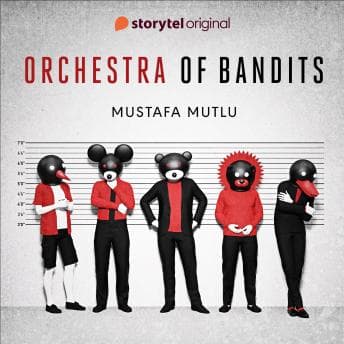
Mustafa Mutlu is doing something genuinely clever here, and Arditti clearly understood the assignment. Those cartoon character masks the robbers wear? The children's story narration? It's not a mistake - it's the point. This is a heist story wearing a fairy tale costume, and as the layers peel back, as you learn what each robber is atoning for, as you realize the hostages aren't just victims... the narration shifts. Darkens. Arditti's voice drops into something rawer, more urgent.
I've listened to a lot of audiobooks that try to be subversive. Most of them just end up being annoying. This one actually earns it. The tonal whiplash isn't whiplash at all - it's a slow burn that you don't notice until you're already on fire. (Yes, I'm stealing that line for my podcast. No, I don't care.)
The premise alone hooked me: five robbers in cartoon masks, a bank heist that becomes a live-streamed national event, and everyone - robbers and hostages alike - carrying sins they need to confess. It's part crime thriller, part morality play, part media satire. The "who's really guilty here" question gets twisted in ways I genuinely didn't see coming.
Arditti's Slow-Burn Transformation
Look, I couldn't find much about Philip Arditti's other work before this, but based on this performance? The man understands that narration is acting. The children's story voice isn't lazy - it's a character choice. He's playing the role of a storyteller who's about to show you something uncomfortable, and he wants you relaxed first. Off-guard.
By the midpoint, his delivery had completely shifted. The emotional beats hit harder because he'd earned them. There's this moment - I won't spoil it - where one of the robbers explains why they're there, what they're trying to make right, and Arditti's voice just... cracks. Not melodramatically. Just enough. The kind of crack that sounds like someone actually feeling something.
I listened to the last four hours in one sitting. In the dark. (Mistake? Maybe. Worth it? Absolutely.) My apartment was completely silent except for Arditti's voice and my own occasionally held breath.
The Heist That's Not Really About the Heist
This is redemption fiction disguised as a thriller. And I mean that as the highest compliment. The bank robbery is almost beside the point - it's the mechanism that forces everyone to confront what they've done, what's been done to them, what justice actually means when the system fails.
The media satire element is sharp without being preachy. The whole country watching the heist live, picking sides, turning criminals into folk heroes or villains based on nothing but narrative preference? Yeah. That landed.
My one gripe - and it's minor - is that the ending feels slightly rushed compared to the meticulous buildup. Eleven hours of slow-burn tension, then the resolution comes a bit quick. Not unsatisfying, just... I wanted to sit in it longer.
Would I Listen Again?
Honestly? Yes. There are layers here I'm sure I missed. And knowing where it's going, I think the early "fairy tale" narration would hit completely different on a relisten.
Who Should Listen (And Who Should Skip)
If you need clear heroes and villains, skip this one. But if you can handle moral ambiguity, violence, and darkness that unsettles without being horror? You need this. That same moral murkiness lives in Works of Edgar Allan Poe, Raven Edition, Volume 2, though Poe takes you to much darker psychological places.
My podcast listeners are going to love this one. It's exactly the kind of genre-bending, expectation-subverting work that makes me remember why I do what I do. Finally - a thriller that respects the genre while pushing against it.
Shirley (my cat) was unimpressed. I was captivated.









