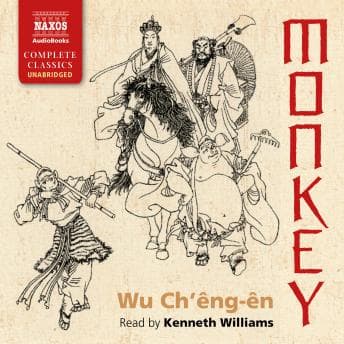

Look, I need to get something off my chest right up front: whoever let Kenneth Williams - the Kenneth Williams, king of the British double entendre and Carry On films - loose on a 16th-century Chinese classic deserves either a medal or a court martial. I genuinely can't decide which.
I started this one on a late-night drive back from a client site in Houston, windows down, Ranger asleep in the back seat, and within fifteen minutes I was laughing so hard I almost missed my exit. Not because Journey to the West isn't serious literature - it absolutely is - but because Williams attacks this text like a man who's been told he has thirteen hours to chew every piece of scenery in ancient China and by God he's going to do it.
A Carry On Film Set in the Tang Dynasty
Let me cut to the chase on the narration, because that's where this audiobook lives or dies. Kenneth Williams rolls his r's like a Victorian stage actor, gives Pigsy what sounds like a working-class Midlands accent, and turns the Jade Emperor into something approaching a flustered British headmaster. Chinese names? Butchered with cheerful abandon. If you're a scholar of Mandarin pronunciation, you will suffer. No way around it.
But here's the thing - and I say this as someone who usually can't stand when performers take liberties with source material - it works. Mostly. Williams seems to understand that Monkey is fundamentally a comedy. It's satire. Wu Ch'êng-ên was poking fun at bureaucracy, at religious pomposity, at the whole apparatus of imperial Chinese governance. And Williams' theatrical instincts lock into that frequency. His Monkey King is this manic, preening troublemaker whose voice practically vibrates with barely contained chaos, and then he'll shift to the Tripitaka sections with this almost sedate, measured tone that gives you room to breathe. The contrast keeps thirteen-plus hours from becoming exhausting.
Does it get silly? Yeah. Sometimes too silly. There were stretches where I felt like I was listening to a pantomime rather than one of the four great classical novels of Chinese literature. But then he'd hit a passage about Monkey's imprisonment under the mountain or the Buddha's cosmic indifference, and something in Williams' delivery would go quiet and precise, and you'd remember - oh right, this is actually about something.
The Waley Problem (Or Gift, Depending on Your Perspective)
I should mention that this isn't the full Journey to the West. Arthur Waley's 1942 translation is heavily abridged - we're talking maybe a third of the original hundred chapters. If you're coming to this wanting the complete epic, all eighty-one tribulations, every demon encounter catalogued and resolved, you're going to feel shortchanged.
What Waley kept, though, is the good stuff. The early chapters covering Monkey's rebellion against Heaven are genuinely wild - this stone-born ape storms the celestial palace, eats the peaches of immortality, fights every army the gods can throw at him, and basically tells the entire cosmic order to go pound sand. That's compelling reading in any century. The pilgrimage itself moves briskly because Waley trimmed the repetitive monster-of-the-week encounters that plague the full text. As someone who's sat through plenty of briefings that could've been emails, I appreciated the efficiency.
Who Should Mount This Cloud
Worth your time? Here's the debrief. If you want an accessible entry point into one of the most important works of world literature - and you can tolerate (or better yet, enjoy) a flamboyantly British theatrical performance - this is genuinely entertaining. Williams won an AudioFile Earphones Award for this, and I get why. The man commits fully.
But if mispronounced Chinese names are going to grind your gears the way a journalist calling an M4 an "assault weapon" grinds mine, you might want to find a different recording. And if you're a Journey to the West purist who needs the complete text, this abridged version will frustrate you.
For me? I put it at 1.25x (my standard operating speed) and it hit just right. Williams' theatrical pauses tighten up nicely, the pacing stays sharp, and the comedy lands faster. Linda walked past my office at one point, heard what sounded like a Shakespearean actor doing a Chinese demon voice in a Cockney accent, gave me the look she reserves for when I watch bad action movies, and kept walking.
Mission Debrief: Weird, Wild, and Worth the Trip
This is not the audiobook I expected. It's stranger, funnier, and more uneven than I anticipated. But I kept coming back to it, and that counts for something. Monkey himself - arrogant, brilliant, ungovernable, loyal despite himself - is one of the great characters in world literature, and Williams understood that better than his mangled pronunciation might suggest. I got that same feeling of stumbling onto a genuinely great character when I read Amazing Adventures of Kavalier & Clay - that sense that the author built someone so alive on the page that you'd follow them anywhere, even when they're making a mess of everything. Ranger slept through most of it, but he perked up every time Williams did the Monkey voice. Take that as you will.