
What does it actually cost a mother to be good at her job? Not in the abstract, self-help-book sense. In the specific, your-daughter-is-in-danger-and-you're-processing-a-crime-scene sense.
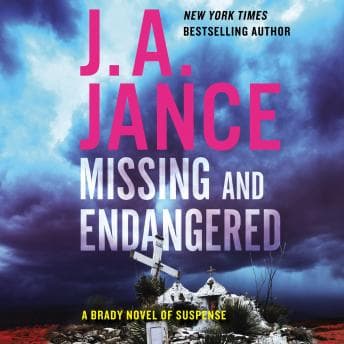
I picked up Missing and Endangered during a long Sunday of cooking — I was making my mother's dal makhani, which requires approximately forty minutes of stirring and zero intellectual engagement, and I needed something that would hold my attention without demanding my eyes. By the time the lentils were done, I was completely invested in Joanna Brady's particular brand of professional-personal collision, and mildly annoyed that I had to eat dinner.
The Psychology of a Woman Who Can't Stop Working
Here's what Jance gets right that a lot of thriller writers fumble: Joanna Brady isn't stretched thin because the plot requires it. She's stretched thin because that's what competent, conscientious women in positions of authority actually experience. The officer-involved shooting subplot — two children left in jeopardy, a community watching — isn't just a B-plot device. It's the structural argument of the entire book. Joanna cannot give Beth Rankin, her daughter's vulnerable new roommate, the attention the situation deserves, because real emergencies don't queue politely.
The protagonist exhibits classic caregiver-identity conflict: her professional competence is precisely what makes her personal failures feel so acute. I found myself asking: why does Joanna's inability to fully protect Beth sting more than her actual investigative challenges? And the answer the book quietly offers is that Beth represents the version of Jenny that Joanna fears — a young woman who wasn't protected in time. That's not subtext. That's the whole emotional engine.
Beth herself is a fascinating case study in what happens when an overprotected adolescent gets sudden, unsupervised internet access. Jance doesn't sensationalize it. The naïveté reads as genuinely tragic rather than stupid, which is harder to pull off than it sounds. The research actually shows that sheltered adolescents don't lack intelligence — they lack calibrated threat assessment. Beth has all the intellectual capacity and none of the pattern recognition. Jance clearly understands this distinction. The same careful handling of a young person's psychological blind spots — the gap between intelligence and pattern recognition — is something I kept thinking about while reading Case of the Golden Bullet, though that book is considerably less generous toward its naive characters.
Hillary Huber and the Specific Problem of Young Characters
Single narrator, 10.5 hours, a cast that spans a seasoned sheriff, a naive sixteen-year-old, young children, and various law enforcement personnel. That's a lot of pitch management.
Huber handles the tonal range well — her Joanna is authoritative without being flat, and her Beth is appropriately uncertain without tipping into caricature. What I noticed specifically is how she handles the children caught in the officer-involved shooting case: there's a fragility in those voices that doesn't feel performed. It feels calibrated. The contrast between how she voices Beth (a teenager performing confidence she doesn't have) and how she voices the younger children (genuinely unguarded) shows real interpretive thought.
The pace matches the book's rhythm, which is character-driven and occasionally slow in the way that a long-running series can be — this is book 20-something, and Jance knows her readers are here for the accumulation of Joanna's life, not just the plot mechanics. If you're new to the series, Huber's consistency with returning characters won't mean much to you yet. If you're a longtime listener, apparently it feels like coming home. I'm somewhere in the middle — familiar enough with the series to appreciate the continuity, not so embedded that I'm nostalgic.
No audio issues worth noting. Clean production, no distracting artifacts. Unremarkable in the best way.
Who This Is Actually For (Honest Version)
If you've never read a Joanna Brady book: you can start here, but you'll be doing some work. The emotional weight of certain relationships assumes history. You'll follow the plot fine. You'll feel the character resonance less.
If you're a series reader: this is exactly what you want. The professional-personal collision is the series at its most thematically coherent, and the Beth storyline handles online exploitation with more psychological accuracy than most thrillers manage.
If you want relentless plot momentum: this isn't your book. Jance is interested in the texture of a life, not just the mechanics of a case. Psychologically, that's the correct choice. Commercially, it means some listeners will find it slow.
My therapist would have thoughts about Joanna Brady. Specifically, about the way she processes guilt through action, and whether solving cases is actually helping her or just giving her somewhere to put the anxiety. But that's a separate session.
Borrow it. Or buy it if you're already invested in the series.