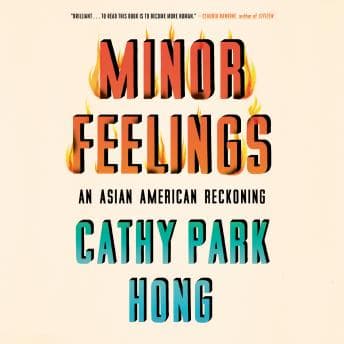

Cathy Park Hong's voice hits you like a confession you weren't prepared to hear. Within the first few minutes of Minor Feelings, you understand this isn't going to be a comfortable listen—and that's precisely the point.
I found myself returning to this audiobook during late-night walks, when the streets were empty enough to actually sit with what Hong was saying. There's something about her delivery—precise, almost clinical at times, then suddenly cracking open with dark humor—that demands your full attention. This isn't background listening. This is the kind of audiobook that stops you mid-stride.
A Poet Reading Her Own Reckoning
Hong, a poet by trade, reads her own work with the rigor you'd expect from someone who has spent years weighing every syllable. Her narration carries a deliberate weight, each sentence landing with intention. When she describes what she calls "minor feelings"—that dissonance between American optimism and the reality of being Asian American—her voice embodies that very tension. She sounds matter-of-fact when describing experiences that are anything but ordinary, and that contrast is devastating.
The book itself defies easy categorization. Part memoir, part cultural criticism, part reckoning with the English language itself, Hong moves between personal history and broader examinations of race in America. She writes about her Korean immigrant parents, about depression and shame, about the particular invisibility that Asian Americans navigate. She interrogates her own friendships, her relationship to poetry, her place in a country that simultaneously claims her and refuses to see her.
When Sarcasm Lands Better Out Loud
What makes the audiobook format particularly powerful here is hearing Hong's sarcasm land in real time. On the page, her wit might read as cutting. In her voice, it becomes something more complex—self-aware, a little weary, wickedly funny. There's a passage where she discusses the model minority myth with such breezy contempt that I actually laughed out loud, alone on a dark sidewalk. That's the kind of writer she is. That's the kind of narrator she is.
Not every essay hits with equal force. The collection has an intentional unevenness—Hong is circling her subjects rather than marching toward a thesis. Some listeners will find this frustrating, particularly if they're expecting a straightforward narrative arc. A few essays meander in ways that feel less purposeful, and the cadence occasionally stumbles. But these moments are minor compared to the essays that absolutely land. Her piece on the artist Theresa Hak Kyung Cha is haunting. Her examination of female friendship is uncomfortably honest. Her dissection of shame—both personal and inherited—is the kind of writing that rewires how you think.
The production quality is clean throughout, with no distracting audio issues. This is Hong, a microphone, and her words. Nothing gets in the way.
Content Worth Knowing About
I should note the content warnings: Hong discusses racial trauma directly, including slurs. She writes frankly about depression. There are references to violence. This is not a book that protects you from discomfort—it's a book that argues discomfort is where understanding begins.
Who This Is (and Isn't) For
For listeners interested in Asian American identity, this is essential. For anyone who has felt the cognitive dissonance of being told their experiences don't match the national narrative, Hong's framework of "minor feelings" offers language for something previously unnamed. Educators and book clubs focusing on race will find rich material here. Fans of Claudia Rankine's Citizen will recognize a kindred sensibility.
But if you're looking for something light, or if you prefer your nonfiction with clear resolutions, skip this one. Hong offers questions more than answers. She offers her own contradictions rather than pretending toward coherence. That refusal to provide easy answers reminded me of the moral complexity in Ordinary Men, where Browning similarly resists simplifying human behavior into comfortable narratives. Some readers have found this frustrating—a few reviews critique the book as too personal, too grievance-driven. I'd argue that's missing the point. Hong isn't trying to speak for all Asian Americans. She's trying to speak honestly about one Asian American psyche, and in doing so, she illuminates something larger.
Why the Author's Voice Matters Here
Hearing the author read her own work adds a layer that print cannot replicate. When Hong pauses before a particularly loaded sentence, when her voice drops to something almost private, you're not just reading her thoughts—you're being invited into them. It's intimate in a way that feels earned rather than forced.
This is a Pulitzer Prize finalist and National Book Critics Circle Award winner for good reason. It's the kind of book that changes how you see, and the audiobook format—with Hong's own voice as your guide—makes that seeing feel like a shared act. Not comfortable. Not easy. But necessary.