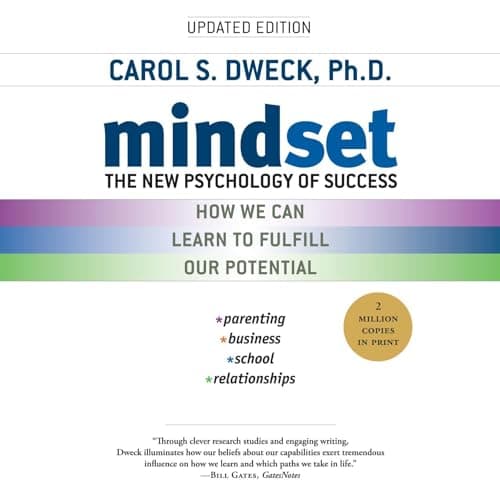

I was chopping onions for a chana masala at 10 PM on a Tuesday — eyes watering, hands busy, brain supposedly off-duty — when Carol Dweck dropped a case study about a kid who, upon being told he'd failed a test, said "I love a challenge." And I stopped mid-chop. Not because I was moved. Because I was professionally suspicious. What seven-year-old says that? My therapist would have thoughts about that child.
But that's the thing about Mindset. It keeps presenting you with anecdotes that sound almost too clean, and then it backs them up with enough research scaffolding that your skepticism slowly deflates. As someone who reads psychological studies the way other people read mystery novels — looking for where the logic breaks — I found myself in a weird push-pull with this book the entire ten hours.
The Core Idea Is Simple, Which Is Both Its Power and Its Problem
Dweck's central thesis: people who believe intelligence and talent are malleable (growth mindset) outperform people who believe those traits are fixed (fixed mindset). That's it. That's the whole book. And she spends roughly ten hours and twenty-three minutes proving it across domains — education, sports, business, relationships.
The research actually shows this framework has real predictive power. Dweck's studies on how praise language ("you're so smart" vs. "you worked so hard") shapes children's willingness to attempt harder tasks? Genuinely fascinating case study material. I teach this stuff. The data on how fixed-mindset CEOs at companies like Enron created cultures of performance theater rather than actual learning — that section hit different after spending a decade in academia, which has its own performance theater issues (don't get me started).
But here's where my BS detector flickered: the book sometimes reads like a hammer looking for nails. Relationship failing? Fixed mindset. Business collapsing? Fixed mindset. Bad at sports? You guessed it. Every cautionary tale lands squarely in confirmation bias territory — Dweck selects examples that prove her point, and I found myself asking: where are the cases where someone with a growth mindset still crashed and burned? She addresses this in the updated section on "false growth mindset," which is genuinely the most interesting part of the book and the reason to get this edition specifically. She essentially acknowledges that people weaponized her concept into toxic positivity, and she's trying to course-correct. That kind of intellectual honesty? Rare in the self-help space.
Bernadette Dunne Reads Like She's Presenting at a Conference (and Not in the Fun Way)
Let me be straight about the narration: Bernadette Dunne sounds kind of robotic for the first couple hours. There's a measured, almost clinical cadence that made me feel like I was listening to a textbook being read aloud rather than a book about the messy, beautiful process of human learning. I kept adjusting the playback speed — settled on 1.25x, which helped considerably.
Dunne's clinical precision actually worked better for me in Democracy in Chains, where that same conference-presenter register matched the material perfectly — but a book about human growth really does want more warmth in the delivery.
The weird thing is, by hour four or five, either Dunne loosens up or your ear calibrates. Her clarity becomes an asset when Dweck gets into denser research sections. She's not trying to perform the book; she's delivering it. And for a psychology text, that actually works once you stop expecting warmth. But if you're coming from, say, an Angela Duckworth or Brené Brown audiobook where the author narrates with personal fire, the temperature difference will be noticeable.
Where the Psychology Doesn't Track
Psychologically, this doesn't track in a few places, and I want to be honest about that. Dweck leans heavily on binary categorization — you're either growth or fixed — when most contemporary personality research suggests we exist on spectrums that shift by context. I can have a growth mindset about my research abilities and a profoundly fixed mindset about my capacity to parallel park (I will never get better at this, don't @ me). The book acknowledges this somewhat but keeps snapping back to the binary because, well, it's tidier.
The anecdotes about athletes and business leaders — Michael Jordan, Jack Welch, John Wooden — are effective but occasionally feel like biographical cherry-picking dressed up as psychological evidence. Dweck understands human nature broadly, but she sometimes smooths out complexity to keep the narrative clean. As someone who writes papers about how stories shape identity, I recognize the move. It's good storytelling. It's slightly less rigorous science.
The chapter on relationships, though, was genuinely surprising. The section on how fixed-mindset partners expect their significant others to read their minds — "If you loved me, you'd just know" — and how growth-mindset couples treat conflict as data rather than verdicts? That's the kind of practical application that makes the book worth your time despite its structural repetitiveness.
Who Should Listen (And Who Should Skip)
If you're a parent, teacher, or manager, the sections on praise language and feedback will genuinely change how you talk to people. That's not hype. The framework is simple enough to implement tomorrow. If you're a psychology nerd hoping for methodological rigor, you'll enjoy about sixty percent of this and spend the other forty percent arguing with your dashboard. Skip it if you've already read deeply in motivation research — you'll find the repetition grating rather than reinforcing.
The ten-hour runtime is honestly about three hours too long for the concept density. Dweck makes her point, then makes it again in a different domain, then makes it a third time. You feel the book-deal page count requirements at work.
Case Notes
I finished the chana masala. I finished the book. Both were fine — satisfying, a little repetitive in spots, and better than expected once I stopped resisting. Mindset isn't going to blow the mind of anyone already familiar with motivation research, but as a gateway into understanding why you flinch when things get hard? It's a solid diagnostic tool. Dweck gave psychology a sticky concept that actually escaped the lab and entered everyday language. That's rarer than you'd think. And the updated section on false growth mindset shows a researcher willing to publicly refine her own thinking — which is, if you think about it, the most growth-mindset thing she could've done.