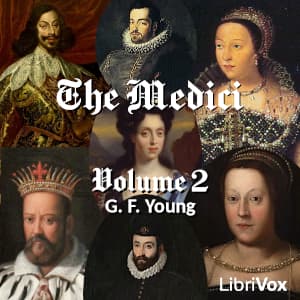

Look. I need to rant about something before we even get into this audiobook. Fifteen hours. Fifteen hours of Renaissance history, and G.F. Young - writing in 1909, mind you - still manages to throw shade at Catherine de' Medici like he's writing a gossip column. The man cannot mention her without some backhanded comment about her "Italian cunning" or her "Florentine methods." Sir, she was trying to keep France from imploding while three of her sons took turns being terrible kings. Cut the woman some slack.
Okay. Rant over. Mostly.
When Your Night Shift Brain Craves Something Dense
I started this one during a stretch of particularly brutal nights - three codes in one shift, the kind where you don't want fiction, you want facts. Something that makes your brain work without making you feel anything. The Medici family's slow-motion collapse over two centuries? Perfect. These people had problems that make my unit's drama look like nothing.
This second volume picks up after the assassination of Alessandro de' Medici in 1537 and follows the family through Catherine's wild ride in France, then shifts to the younger branch - the Grand Dukes of Tuscany - until the whole line just... ends. No heirs. Done. 1743. Three centuries of power, scheming, and art patronage, finished because nobody could produce a surviving child. As someone who's actually worked in healthcare, I kept thinking about what we'd know now versus then. All those Medici babies that didn't make it. The irony of a family that funded so much medical advancement being unable to save themselves.
LibriVox Roulette: The Volunteer Experience
Here's the thing about LibriVox productions - and I say this with love, because free audiobooks are a gift - you never quite know what you're getting. Multiple volunteer readers means multiple styles, accents, recording qualities. Some chapters sound like someone's reading in a professional booth. Others sound like they're in their kitchen with the dishwasher running. (I'm exaggerating. Slightly.)
The reading itself is clear. You can follow the history, understand the political machinations, keep track of which Cosimo is which - and trust me, there are several Cosimos. But there's no... performance. This is reading, not narration. Which, for dense 1909 historical prose, might actually be the right call? Young's sentences are already doing a lot of heavy lifting. Adding dramatic interpretation might have been too much. I had a similar experience with the straightforward narration in Ordinary Men - sometimes dense historical material needs clarity over performance.
If you're used to polished Audible productions with sound design and celebrity narrators, this will feel stripped down. But at 3 AM when you just want information delivered competently into your tired brain? It works.
The Actual History (Which Is Genuinely Wild)
Young does something I appreciate - he doesn't just list dates and deaths. He connects the Medici to everything happening in Europe. Catherine's influence on French politics during the Wars of Religion. The Grand Dukes' complicated dance with the Habsburgs. How the family's art patronage shaped what we now call the Renaissance.
The later Medici are honestly kind of sad. The Grand Dukes become increasingly irrelevant, their power shrinking, their line weakening. The last Medici, Anna Maria Luisa, negotiated that all the family's art collections would stay in Florence forever. That's why the Uffizi exists as it does today. One woman's final act of defiance against extinction.
Carlos asked why I was crying in the car. I blamed allergies. But honestly? There's something about watching a family that shaped Western civilization just... fade out. No dramatic ending. Just no more babies.
Who This Is (and Isn't) For
This is not casual listening. The prose is formal - 1909 formal - and the political details are dense. Planning a trip to Florence and want context for every painting you'll see? This is your homework. History nerd who wants primary source energy without actually reading primary sources? Solid choice. Want something light for your commute? Absolutely not. Skip this one.
The LibriVox format means it's free, which honestly changes the calculation. Would I spend a credit on this? Probably not - the production quality doesn't justify it when you can stream it for nothing. But for free? For anyone interested in Renaissance history, art history, or just the slow tragedy of powerful families? Worth the time.
Night Shift Prescription
This audiobook is like a strong cup of coffee for your brain - not pleasant exactly, but effective. It kept me awake through charting, taught me things I didn't know, and reminded me that no matter how bad my shift gets, at least I'm not trying to prevent the extinction of my entire family line while also managing a duchy.
My mom would love this. She'd also spend the whole time comparing the Medici to various Filipino political families. She wouldn't be wrong.






![Steve Jobs [unabridged audiobook] audiobook cover](/_next/image?url=https%3A%2F%2Fcovers.audiobooks.com%2Fimages%2Fcovers%2Ffull%2F9788499923406.jpg&w=1920&q=75)