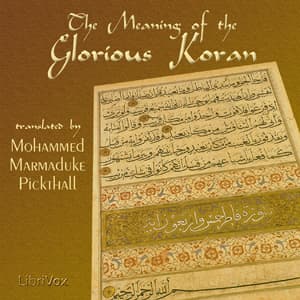

Let me start with the complaint that's been nagging at me since I pressed play: sixteen and a half hours of LibriVox volunteers reading one of the most significant religious texts in human history, and nobody thought to coordinate the pronunciation of Arabic terms?
I'm being unfair. I know I'm being unfair. But when you've spent twenty years teaching teenagers that consistency matters in interpretation, you notice these things. One reader says "surah" one way, another treats it like it's from a different language entirely. And look—I get it. These are volunteers. They're doing this for free, for the love of literature and accessibility. That's genuinely beautiful. But the Qur'an isn't just any text, and Pickthall himself would probably have strong opinions about the matter.
The Pickthall Problem (And Why It Doesn't Matter As Much As You'd Think)
Here's what I kept thinking about while walking the lakefront at dawn last week, Denise still asleep and the city quiet enough to actually concentrate: Pickthall was a convert. An Englishman who embraced Islam and then spent years wrestling with how to render Arabic revelation into English prose. He called this a "translation of the meaning" rather than a true translation—because he believed, as many Muslims do, that the Qur'an in Arabic is inimitable. Untranslatable in the deepest sense.
So what we're listening to is already an interpretation of an interpretation. The LibriVox volunteers are a third layer of remove from the original text. And somehow—somehow—this works more often than it doesn't.
Pickthall's English has a King James cadence to it. Formal. Elevated. The kind of prose that demands you slow down. One reviewer called it "near perfect," and I understand why. There's a rhythm to how Pickthall arranges his sentences that survives even inconsistent narration. When you hit a surah like Al-Fatiha or Ar-Rahman, the language carries itself. The volunteers don't need to perform it. They just need to get out of the way.
What American Voices Do To Sacred Text
One listener felt "cheated" that these aren't recordings by Pickthall himself. I understand that disappointment—there's something lost when you don't hear the translator's own voice, his own emphasis on which words mattered to him. But Pickthall died in 1936. We were never going to get his voice.
What we get instead is a democratic reading. Multiple Americans, different backgrounds, different approaches. Some read with reverence. Others read more neutrally, like they're presenting information rather than scripture. Neither approach is wrong, exactly. But if you're coming to this expecting the kind of unified artistic vision you'd get from a Simon Vance or a Frank Muller—that's not what LibriVox does.
And here's where I'll defend the project: there's something appropriate about community voices reading a text that built communities. The Qur'an was revealed to be recited aloud, shared, memorized, passed from person to person. Hearing different voices isn't a bug. It might actually be a feature.
(My students would roll their eyes at that take. "Mr. Williams is doing his English teacher thing again." They're not wrong.)
Who Should Press Play—And Who Shouldn't
Let me be direct. If you're a practicing Muslim seeking a devotional listening experience, this probably isn't your first choice. You want proper tajweed, Arabic recitation, the real thing. This is Pickthall's English interpretation read by well-meaning volunteers.
But if you're a curious non-Muslim—a student of comparative religion, someone who wants to understand what's actually in this book that shaped a billion lives—this is genuinely valuable. Sixteen hours is a commitment, yes. But you can take it surah by surah. The chapters aren't arranged chronologically anyway. You can start with the shorter ones at the end, the way many Muslims recommend for beginners.
If you're teaching world literature or religious studies and need something accessible and free, this exists. That matters.
And if you're like me—someone who believes that understanding other people's sacred texts is part of being an educated human—this is worth the inconsistencies.
Class Dismissed (But Keep Thinking)
I finished this during a particularly tedious budget presentation. (Sorry, Principal Martinez. Still wasn't listening.) And what struck me most was how much of this text I recognized from echoes in other traditions. Abraham. Moses. Jesus. Mary. The stories aren't unfamiliar if you know your Bible. But the emphasis is different. The theology is different. Love and Respect explores a different kind of divine framework—how men and women are wired to need different things in relationships. The relationship between human and divine here is framed in ways that made me think harder about my own assumptions.
This is why we still read the classics. Not because they're comfortable, but because they show us how other people have understood the fundamental questions.
The audio quality is clean. The volunteers are earnest. Pickthall's translation remains one of the most respected English versions available. Is it perfect? No. But perfection wasn't the point. Accessibility was. And on that count, this delivers.