
"Manuscripts don't burn."
I hit pause on that line somewhere around hour twelve, standing on the lakefront with the November wind cutting through my jacket, and just... stood there. Denise texted asking where I was. I didn't answer for ten minutes. This is what Bulgakov does to you.
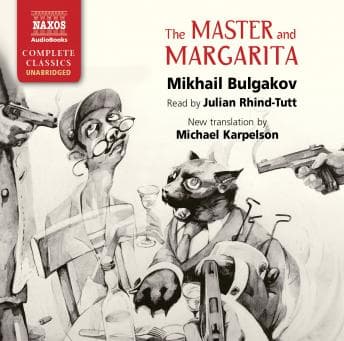
I've taught Soviet literature in my AP class exactly twice—both times students complained it was "depressing." They're not wrong. But *The Master and Margarita* isn't depressing. It's unhinged. It's a novel where Satan throws a ball in Moscow, a giant cat named Behemoth carries a pistol and drinks vodka, and the most tender love story you'll encounter this year exists alongside bureaucrats literally losing their heads. My students would hate this. I love it.
Julian Rhind-Tutt Understands That Chaos Requires Discipline
Here's the thing about narrating Bulgakov: the text is already doing so much work that a lesser narrator would either try to match its mania (exhausting) or play it straight (boring). Rhind-Tutt does neither. He gives the whole thing a decidedly Cockney spin that sounds insane on paper—a Russian satirical novel delivered with British working-class inflections?—but somehow it works. The effect is like watching a very proper English actor perform commedia dell'arte. The formality makes the absurdity sharper.
Woland, the Devil himself, gets this low, almost amused delivery that made me genuinely uneasy during the Variety Theatre sequence. Not because Rhind-Tutt was trying to sound sinister—because he wasn't. He sounded like a man who finds everything slightly boring except human greed. That's terrifying.
And then there's the Pontius Pilate chapters. Rhind-Tutt shifts into something slower, more weighted, for these Jerusalem sequences. The contrast between Moscow's frenetic satire and Pilate's existential exhaustion is already built into the text, but the narrator makes you *feel* the gear change. By hour four of the Pilate storyline, I'd forgotten I was listening to the same person.
The Prose Deserves 1.0x Speed (Even When It's Ridiculous)
I listened at 1.0x because—and I will die on this hill—the author chose those words. Bulgakov wrote this book knowing it might never be published, knowing it could get him killed, and he still made it funny. The scene where Margarita flies naked over Moscow on a broomstick, smashing windows and flooding an apartment with her bathwater? Rhind-Tutt delivers it with such unflagging energy that I laughed out loud during a faculty meeting. Principal Martinez asked if I was okay. I was not okay. I was watching a witch destroy a literary critic's apartment.
But the book isn't all chaos. The love story between the Master and Margarita is genuinely moving—tender in a way that sneaks up on you. Rhind-Tutt's voice shifts when Margarita appears, becomes softer, almost reverent. It's the performance of someone who understands that pause is punctuation. The sixteen-hour runtime feels earned, not padded.
Who Should Listen (And Who Should Run)
If you need your narratives linear and your symbolism explained, this isn't your book. Bulgakov wrote *The Master and Margarita* as a critique of Soviet censorship wrapped in a theological meditation wrapped in a screwball comedy wrapped in a love story. It requires focus. I tried listening while grading papers and had to restart an entire chapter because I'd missed Behemoth the cat's entire conversation with a streetcar conductor.
But if you loved *Crime and Punishment* and wished Dostoevsky had a sense of humor—this is its spiritual successor. That same blend of literary weight and accessibility shows up in Lincoln Highway: A Read with Jenna Pick (A Novel), though Towles trades Moscow for 1950s America. If you've ever wanted to understand why Russian literature matters without slogging through 800 pages of misery—start here. If you're the kind of person who thinks the Devil should be charming rather than scary—Woland will become your favorite literary villain. Skip it if you can't handle narrative whiplash between crucifixion and a vodka-drinking cat.
Worth Pausing the Faculty Meeting For
This is why we still read the classics. Not because they're Important with a capital I, but because a man in 1930s Moscow wrote a book about the Devil hosting a magic show, and somehow it's the most honest thing I've heard about art, love, and what we owe each other. The Earphones Award was deserved. Rhind-Tutt gives a performance that respects the source material while making it completely accessible to modern ears.
Seventeen hours. Worth every minute. My students would probably still hate it. But I'm assigning it anyway.