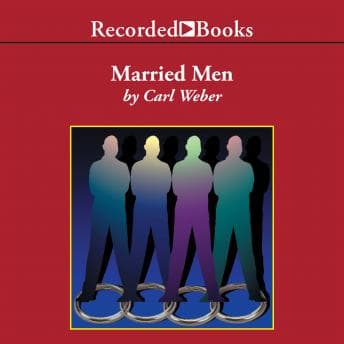

"Men are simple creatures. We just want to be fed, loved, and left alone."
I don't remember the exact timestamp - somewhere around hour three - but one of the four husbands drops a line like this with such casual conviction that I actually laughed out loud during a faculty meeting. Principal Martinez looked at me. I pretended I'd read something funny in a student essay. (Nobody writes anything funny in student essays. She didn't buy it.)
Carl Weber's Married Men is not the kind of book I'd normally queue up. I'm the guy who spends three podcast episodes dissecting the moral architecture of Anna Karenina. But here's the thing about twenty years of teaching literature to teenagers - it teaches you that stories about people making spectacular messes of their lives are universal. Tolstoy knew it. Weber knows it too, just with more Viagra jokes and fewer Russian estates.
Four Guys, Four Marriages, Zero Impulse Control
The setup is deceptively simple: Kyle, Allen, Wil, and Jay are lifelong friends who all manage to torpedo their marriages in various creative ways and end up kicked out of their homes. What follows is 14 hours of bad decisions, worse rationalizations, and the kind of male bonding that happens when four grown men are collectively sleeping on couches, hiding in hotels, and appearing in court.
Weber writes these men with genuine affection but doesn't let them off the hook. They're not villains - they're recognizable. The guy who can't stop lying even when the truth would save him. The one who genuinely loves his wife but can't keep his hands to himself. The friend who gives great advice he'd never follow. I've had versions of all four of these men in my classroom, just younger and with less alimony to worry about.
The "Waiting to Exhale on testosterone" comparison in the marketing is actually pretty apt, though Weber's approach is less cathartic and more comedic. The humor is raw, sometimes crude, but it lands because these characters feel like real people fumbling through consequences they earned. There's a sequence involving a divorce court appearance that's so painfully awkward I had to pause the book and take a lap around the kitchen because I was cringing too hard to sit still.
Five Narrators and Not a Wasted Voice
This is where the audiobook earns its keep. Five narrators - Dion Graham, Julia Gibson, Kevin R. Free, Marc Johnson, and Sisi Aisha Johnson - and the production team actually uses them well. This isn't a case of multiple narrators stepping on each other or creating tonal whiplash. Each voice owns their character's perspective so completely that by the midpoint, you stop thinking about narrators and just hear people talking.
Dion Graham is, predictably, the anchor. The man is an AudioFile Golden Voice for a reason. His pacing does this thing where he slows down right before a character is about to rationalize something terrible, and that slight drag - that half-beat of hesitation - tells you everything about what's coming. The narrator understands that pause is punctuation. Kevin R. Free handles the comedic beats with real skill; there's a scene where his character is trying to explain himself to his wife and Free's voice gets progressively higher and faster, like a man watching his alibi disintegrate in real time. It's genuinely funny performance work.
Julia Gibson and Sisi Aisha Johnson bring the wives into sharp focus, which matters because Weber could have easily written them as one-dimensional obstacles. The women sound exhausted and angry in specific ways - not generic "wronged wife" anger, but the particular fury of someone who's had this same argument seventeen times before.
The Prose Won't Win Any Pulitzers, and That's Fine
Let me be honest: this is not literary fiction. Weber writes in a straightforward, propulsive style that prioritizes momentum over elegance. My students would probably love this. I love it too, but for different reasons - I appreciate a writer who knows exactly what kind of story he's telling and commits to it fully. The dialogue is sharp and natural, the pacing keeps all four storylines moving without getting tangled, and the emotional beats - when they come - actually hit because Weber has earned them through 12 hours of getting you invested in these idiots.
The book does lean heavily on some familiar tropes, and a few of the romantic subplots follow pretty predictable arcs. But at 14 hours, it never felt padded. That's harder to pull off than people think.
Who Gets an A, Who Gets a Hall Pass
If you want literary fiction, if you need your prose savored at 1.0x for the beauty of each sentence - this isn't that. Go listen to Song of Solomon.
But if you want a smart, funny, character-driven story about marriage, friendship, and the creative ways men destroy their own happiness? If you want to hear five narrators working at the top of their game in a full-cast production that actually justifies having five narrators? Worth pausing the faculty meeting for.
My students would not hate this. That alone is noteworthy. Though for a book that actually made my eighth period class sit up and pay attention last spring, Absolutely True Diary of a Part-Time Indian is the one I keep coming back to when I want proof that voice-driven storytelling can reach people who've decided they don't like reading.
The Red Pen Says
Carl Weber wrote a book that's smarter than its premise suggests, performed by a cast that elevates every page. It won't change your life, but it'll make your commute fly by - and you'll catch yourself thinking about Kyle and Allen and Wil and Jay like they're guys you actually know. Denise overheard a few chapters while we walked the lakefront last weekend. She said, and I quote: "These men are a mess, but at least they're entertaining." High praise from a woman who tolerates my Faulkner episodes.