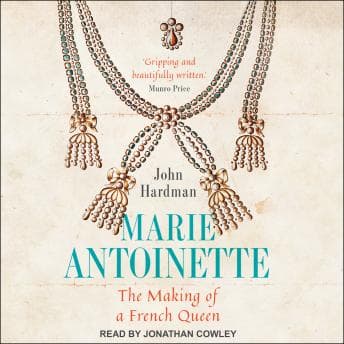

How often do we get to watch history strip away the caricature and hand us the real person underneath?
I've been sitting with this one for a couple of days now, and I'm conflicted in a way that genuinely frustrates me. Because John Hardman wrote something that matters here - a Marie-Antoinette who isn't the cake-obsessed socialite pop culture sold us, but a woman navigating impossible political currents with more savvy than anyone gave her credit for. And then the audiobook production just... let her down. Again. Like the universe can't stop punishing this woman.
She Deserved Better Then and She Deserves Better Now
Let me talk about the book itself first, because Hardman earned that. This isn't your typical "sympathetic retelling" of Marie-Antoinette. He doesn't just soften her image - he fundamentally reframes her political role. The sections on her relationship with her mother Maria Theresa hit me somewhere deep. Here's this young woman, shipped off to France as basically a diplomatic chess piece, and instead of dutifully pushing Austria's aggressive foreign policy agenda, she said no. She prioritized France. She chose her adopted country over her mother's demands. As a first-gen kid who's navigated that tension between loyalty to where you come from and where you are? My heart. MY HEART.
Hardman draws on correspondence and sources I hadn't encountered before to show how Marie-Antoinette essentially took the wheel from Louis XVI when his confidence shattered. The chapters covering her engagement with the Third Estate - actually listening, actually trying to make constitutional monarchy work with former radicals - paint a picture of a woman who was strategic, not frivolous. This isn't revisionist fluff. He builds his case methodically, source by source, and by the halfway point I was genuinely angry on her behalf. Centuries of "let them eat cake" erasure for a queen who was trying to hold a crumbling system together with her bare hands. The way reputations calcify into myth - and how rarely anyone bothers to chip away at them - is something I kept turning over while reading Great Influenza too, where John Barry does the same painstaking work of rescuing real people from the caricatures history pinned on them.
Abuela would have loved this one. She always had a soft spot for women history decided to make into villains. She would've been yelling at the audiobook the way she yelled at telenovelas - "¡Déjenla en paz!"
The Narration Problem That Won't Stop Breaking My Heart
Okay. Here's where it gets painful. I listened to this over three days while working on a rebrand for a local bakery (the irony of designing pastry logos while listening to Marie-Antoinette is not lost on me), and Jonathan Cowley's narration kept pulling me out of the work AND the story. Which is the worst of both worlds.
The mispronunciations are not minor. We're talking about a book steeped in French political history, French names, French places - and the French pronunciation is consistently off in ways that made me wince. I don't need perfection, but when you're narrating a book about the French court and key names keep getting mangled, it creates this constant friction. Like watching a beautifully shot film with the audio slightly out of sync. You can push through it, but you're always aware something's wrong.
The delivery itself is flat in places where the material is genuinely dramatic. Hardman writes about Marie-Antoinette's final political maneuvers with real tension - this is life-and-death stuff, revolution boiling over, a woman fighting for survival and legitimacy - and Cowley reads it like he's narrating a municipal zoning report. The audio quality is also noticeably rougher than what I expect from a published audiobook. There's a thinness to the recording that made me check my headphones twice.
And look, I know not every narrator is Julia Whelan (whose voice is velvet and honey and would have made this book TRANSCENDENT). But for a 17-hour-and-50-minute commitment, the narrator is your companion, and this companion kept stepping on the emotional moments Hardman built so carefully.
Who Gets the Credit and Who Gets the Blame
Here's my honest take: the book deserves a 4. The audiobook deserves maybe a 2.5. I'm splitting the difference but leaning toward the narration damage because this is an audiobook review and the listening experience is the whole point.
If you're a history reader who can tolerate narrator issues because you're there for the content? You'll get something real from this. Hardman is clearly THE expert on this period, and his argument about Marie-Antoinette's political agency is the kind of reframing that changes how you see an entire era. But if narrator quality matters to you the way it matters to me - if a flat delivery or a butchered French name breaks the spell - consider reading the print version instead. I almost never say that. But I'm saying it.
This book felt like finding a gorgeous painting in a frame that's falling apart. The art is there. The scholarship is there. The emotional weight of a misunderstood woman finally getting her story told with care? Absolutely there. I just wish the audio production had matched that care.
Frida Knocked This Off My Nightstand and Honestly, Fair
Read the book. Skip the audiobook. Marie-Antoinette deserved a narrator who could carry the weight of her story, and this wasn't it. Hardman did his part. The production didn't do theirs.